| |
| Alle Journale wurden nach Amyloidangiopathie durchsucht |
Treffer 1 - 3 von 3 |
|
|
|---|
Oberbegriffe: Amyloid,
Angio,
Angiopathie
Unterbegriffe: zerebrale Amyloidangiopathie
Verwandte Begriffe: ATTR-ATAmyloidose,
ATTR-Amyloidose,
ATTR-Amyloidose-Subtypen,
AV-Angiom,
AVERT-Angiographie,
Abschluss-Angiographie,
Abschlussangiogramm,
Abschlussangiographie,
Akut-Koronarangiographie,
Akutangio,
Akutkoronarangiographie,
Amyloid-Transthretin,
Amyloid-ß-Protein,
Amyloidablagerungen,
Amyloidose,
Amyloidose-EKG,
Amyloidose-MRT,
Amyloidose-Skelett,
Amyloidose-Skelett-Szintigraphie,
Amyloidplaques
|
1. Jellinger KA
Lewy-Körper-Demenz und Parkinson-Demenz: aktuelle Konzepte und Perspektiven // Dementia with Lewy bodies and Parkinson disease-dementia: current concepts and perspectives
Alzheimer-Pathologie
Journal für Neurologie, Neurochirurgie und Psychiatrie 2021; 22 (4): 167-174
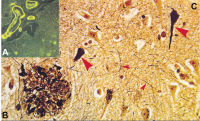
Wesentliche histopathologische Veränderungen bei
M. Alzheimer. (A) Amyloidplaques in der oberflächlichen Hirnrinde und Amyloidangiopathie in meningealen und oberflächlichen Hirngefäßen (Kongorot). (B) Neuritische Plaques und dystrophe Neurite (Bodian). (C) Neurofibrillenveränderungen (große Pfeile) und Neuropilfäden (kleine Pfeile) in der Hirnrinde (Bodian). Keywords: Beta-Amyloidablagerung,
Fibrillendegeneration,
Histologie,
Morbus Alzheimer,
Neurologie,
Pathologie
|
|
|
2. Grossmann K
Alzheimer-Krankheit – können Antikoagulantien helfen? // Alzheimer‘s disease – can anticoagulants help?
Wirkungsweise
Journal für Neurologie, Neurochirurgie und Psychiatrie 2021; 22 (1): 7-10
Vorgeschlagene Wirkungsweise von Antikoagulantien
gegen gefäßbedingte Störungen und ausgelöste Gehirnveränderungen
in der Alzheimer-Krankheit (indirekte, stimulierende Effekte
sind durch gepunktete Linien dargestellt). Die Erklärung erfolgt im
Text. Aß – Amyloid-ß-Protein, FXII – Blutgerinnungsfaktor FXII Keywords: Alzheimer-Krankheit,
Antikoagulans,
gefäßbedingte Störung,
Gehirnveränderung,
Schema,
Wirkung,
zerebrale Amyloidangiopathie
|
|
|
3. Brainin M
Statins and Stroke: A Promising Approach Towards Stroke Prevention
Zerebrale Blutung
Journal of Clinical and Basic Cardiology 2002; 5 (2): 159-162
MR scans of a 74-year old patient with amyloidangiopathyinduced cerebral bleeding in the right parietal subcortex. In the haemosensitive scans (gradient-echo T2* sequences) numerous
additional hypointense lesions are visible, indicating multiple silent cerebral "microbleeds". Such patients might bear an additional risk for a recurrent haemorrhage if cholesterol or LDL is markedly reduced below normal. Keywords: Amyloidangiopathie,
amyloidangiopathy,
Bleeding,
Blutung,
Lesion,
Läsion,
Magnetic Resonance Tomography,
Magnetresonanztomographie,
Microbleeds,
Mikroblutung,
Subkortex,
Subkortex
|
|
|
| |
|

 Suche Medizinische Publikationen
 Suche Abbildungen und Grafiken
 Medizinprodukte - Labortechnik
 Antidotarium (Stand 2012)
 Phytokodex (Stand 2012)
 Fachbücher
 Patientenliteratur