|
|
|---|
1. Brinkers M;
Dombrowsky S;
Pfau G;
Kretzschmar M;
Meyer F
Depressionen bei somatischen Krankheiten am Beispiel der ischämischen Herzkrankheit und ausgewählter Tumorerkrankungen mit beträchtlicher Relevanz für Morbidität und Letalität // Depression in somatic diseases
Übersicht Zusammenhang
Journal für Neurologie, Neurochirurgie und Psychiatrie 2022; 23 (4): 172-184
Zusammenhang Stressreaktionen, Depression, Herzinfarkt, Tumor. Oberer Teil: akute Stressreaktion mit den 4 wichtigen Faktoren (die vier dunkelorangen Kästchen der oberen Abbildung): ZNS, Sympathicus = Locus-coeruleus-Norepinephrin (LC-NE-System), Hypothalamus-Nebennierenmark-Achse (HNS), Entzündungsfaktoren/Zytokine. Unterer Teil: chronischer Stress mit „Zuschaltung“ der Hypothalamus-Hypophysen-Nebennierenrindenachse (HHN).
*Genetische Ursachen depressiver Symptome: Variationen des Serotonintransportergens 5HTT, Variationen des Noradrenalintransportergens, Variationen des FKBP5-Gens, sowie der Enzyme des Monoaminstoffwechsels, der Monoaminoxidase oder der Catechol-O-Methyltransferase (Ãœbersicht bei Stoppel [60])
**Neurobiologische Effekte: reduzierte Endothelregenration, erhöhte Vasokonstriktion, reduzierte elektrophysiologische Stabilität [9].
Nicht berücksichtigt sind weitere Faktoren, die bei Herzinfarktpatienten wie auch depressiven Patienten vorkommen können: Übergewicht, Rauchen,
Diabetes, Hypertonie, negative Life-Events.
Keywords: Depression,
Herzinfarkt,
Psychiatrie,
Schema,
Stressreaktion,
Tumor,
Zusammenhang
|
|
|
2. Kammerlander A
Kardiale Stress-Magnetresonanztomographie // Cardiovascular magnetic resonance imaging (CMR)
Stress-MRT
Journal für Kardiologie - Austrian Journal of Cardiology 2022; 29 (1-2): 41-43
Positives, transmurales Late Gadolinium Enhancement (weiße Pfeile) ohne signifikante Restvitalität nach großem Vorderwandinfarkt.
Zusätzlich zeigt sich ein großer Ventrikelthrombus (*). Keywords: Kardiologie,
Stress-MRT
|
|
|
3. Kammerlander A
Kardiale Stress-Magnetresonanztomographie // Cardiovascular magnetic resonance imaging (CMR)
Stress-MRT
Journal für Kardiologie - Austrian Journal of Cardiology 2022; 29 (1-2): 41-43
Unterschiedliches Ausmaß an Schweregrad des Late Gadolinium Enhancements (weiße Pfeile) bei post-ischämischen Narben (A: negativ;
B: 25 % der Wanddicke betreffend mit erhaltener Restvitalität nach Circumflexa-Infarkt, C: bis 100 % der Wanddicke betreffend ohne Restvitalität nach
LAD-Infarkt). Keywords: Kardiologie,
Stress-MRT
|
|
|
4. Kammerlander A
Kardiale Stress-Magnetresonanztomographie // Cardiovascular magnetic resonance imaging (CMR)
Stress-MRT
Journal für Kardiologie - Austrian Journal of Cardiology 2022; 29 (1-2): 41-43
Positiver Befund einer Stress-MRT im Sinne einer induzierbaren Ischämie (weiße Pfeile) im Bereich der Hinterwand. Bei diesem Patienten zeigte sich im darauffolgenden Herzkatheter eine 90%-ige Stenose
der RCA, welche erfolgreich mit einem Drug-eluting-Stent versorgt werden
konnte. Keywords: Kardiologie,
Stress-MRT
|
|
|
5. Valenta I;
Upadhyaya A;
Leucker T;
Schindler TH
Cardiac positron emission tomography in the identification and characterization of coronary artery disease and microvascular dysfunction // Kardiale PET zur Identifikation und Charakterisierung koronarer Herzkrankheiten und mikrovaskulärer Dysfunktion
PET
Journal für Kardiologie - Austrian Journal of Cardiology 2022; 29 (1-2): 34-40
13N-ammonia PET in the evaluation of CMD. Value of PET-determined hyperemic MBFs and MFR in the identification and characterization of CMD.
A 65-year-old woman with recurrent chest pain and shortness of breath during daily activities. Cardiovascular risk profile with obesity (body mass index
of 40 kg/m2
), dyslipidemia, and hypertension. (A): Regadenoson- stress and rest 13N-ammonia PET/CT images in corresponding short-axis (top), vertical
long-axis (middle), and horizontal long-axis (bottom) slices. On stress-images and rest perfusion images, there is homogenous radiotracer uptake of the
left ventricle. Thus, no reversible radiotracer uptake to suggest regional ischemia and normal rest perfusion. Hemodynamically obstructive CAD lesions
therefore can be widely ruled out. Gated peak-stress and rest PET images (not shown) demonstrated normal left ventricular size and wall motion associated
with a left ventricular ejection fraction of 50% and 52%, respectively. (B): Display of quantitative MBF data unravel globally reduced hyperemic MBFs with
only 1.29 mL/g/min (normal value > 1.80 mL/g/min) and decreased MFR with 1.71 (normal value > 2.0) to signify moderately severe CMD that may reflect
a functional substrate for reported anginal symptoms. Keywords: Kardiologie,
PET
|
|
|
6. Valenta I;
Upadhyaya A;
Leucker T;
Schindler TH
Cardiac positron emission tomography in the identification and characterization of coronary artery disease and microvascular dysfunction // Kardiale PET zur Identifikation und Charakterisierung koronarer Herzkrankheiten und mikrovaskulärer Dysfunktion
PET
Journal für Kardiologie - Austrian Journal of Cardiology 2022; 29 (1-2): 34-40
13N-ammonia PET in the evaluation of multivessel CAD. Value of hyperemic MBFs and MFR in an abnormal 13N-ammonia myocardial perfusion
PET/CT study. A 54-year-old man with increasing chest pain during daily activities. He had previous percutaneous coronary intervention (PCI) with stent
employment in the LAD. Cardiovascular risk profile with advanced obesity (body mass index of 41 kg/m2
), dyslipidemia, and hypertension. (A): Regadenoson- stress and rest 13N-ammonia PET/CT images in corresponding short-axis (top), vertical long-axis (middle), and horizontal long-axis (bottom) slices. On
stress-images, there is a large area of severely decrease in myocardial perfusion, involving the inferior and inferolateral walls extending to the antero-lateral, anterior, and apical wall segments but less in severity that becomes reversible on rest images. In addition, a transient ischemic dilation (TID) of 1.3 is noted on the stress-rest 13N-ammonia images indicative of diffuse ischemia-induced myocardial stunning. (B): Regional myocardial blood flow quantification
(MBF) and myocardial flow reserve (MFR) calculation. The summarized quantitative data signify an impairment of hyperemic MBF in the LAD distribution
(1.58 ml/g/min), but also and more pronounced in the LCx and RCA distribution (1.07 and 1.09 ml/g/min, respectively). Correspondingly, the MFR is abnormally reduced in all three major coronary territories, most pronounced in the LCs (1.29), followed by RCA (1.36), and LAD (1.61) distribution, respectively.
Invasive coronary angiography (not shown) in this patient unraveled indeed severe multivessel CAD accounting for the observed diffuse ischemia. The
proximal LAD had previous extensive stenting without significant stenosis, whilst the mid-portion of the LAD demonstrated a ≈ 90–95% in-stent restenosis.
The LCx demonstrated a 70% lesion in the posterolateral marginal brach, while in a dominant RCA, the posterior descending artery (PDA) was occluded. Keywords: Kardiologie,
PET
|
|
|
7. Glaser F;
Rohla M
Phänomene, erworbene Störungen und Therapie der atrioventrikulären Leitung – ein Update // Phenomena, acquired disorders and therapy of the atrioventricular conduction
AV-Block - LSB
Journal für Kardiologie - Austrian Journal of Cardiology 2020; 27 (7-8): 276-301
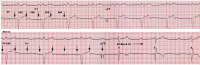
Oben: 2:1-AV-Block und LSB bei einer 72-Jährigen. Einige P-Wellen links sind mit Pfeil markiert. Es besteht auch hier ein ventrikulophasisches PP-Intervall. Unten: Unter emotionalem Stress (Zählen in 3er-Schritten von 200 herunter) Steigerung der Sinusfrequenz und Entwicklung eines 3:1, später eines totalen AV-Blocks mit idioventrikulärem Escape (E) vom Bereich des linken Tawara-Schenkels (die Escape-Komplexe weisen eine RSB-artige Morphologie auf). Die Blockzone liegt im HPS. Aus [19].
Keywords: AV-Block,
EKG,
LSB
|
|
|
8. Weihs W;
Piackova E;
Eichenberg C;
Fiegl J;
Huber K
Das Tako-Tsubo-Syndrom – die stressinduzierte Kardiomyopathie // Takotsubo Syndrome – stress-induced Cardiomyopathy
Tako-Tsubo-Syndrom
Journal für Kardiologie - Austrian Journal of Cardiology 2019; 26 (7-8): 193-197
„Delayed Recovery“ bei einem
Patienten mit apikalem Tako-Tsubo-Syndrom Keywords: Kardiologie,
Tako-Tsubo-Syndrom
|
|
|
9. Weihs W;
Piackova E;
Eichenberg C;
Fiegl J;
Huber K
Das Tako-Tsubo-Syndrom – die stressinduzierte Kardiomyopathie // Takotsubo Syndrome – stress-induced Cardiomyopathy
Laevokardiogramm - Echokardiogramm
Journal für Kardiologie - Austrian Journal of Cardiology 2019; 26 (7-8): 193-197
(A): Laevokardiogramm enddiastolisch;
(B): Konturumzeichnung; (C):
Laevokardiogramm endsystolisch; (D): Echokardiogramm
enddiastolisch mit Konturumzeichnung;
(E): Echokardiogramm endsystolisch
mit Konturumzeichnung. Keywords: Echo,
Kardiologie,
Laevokardiographie
|
|
|
10. Weihs W;
Piackova E;
Eichenberg C;
Fiegl J;
Huber K
Das Tako-Tsubo-Syndrom – die stressinduzierte Kardiomyopathie // Takotsubo Syndrome – stress-induced Cardiomyopathy
Laevokardiogramm - Echokardiogramm
Journal für Kardiologie - Austrian Journal of Cardiology 2019; 26 (7-8): 193-197
(A): Laevokardiogramm enddiastolisch; (B): Kontur; (C): Laevokardiogramm
endsystolisch; (D): Echokardiogramm enddiastolisch; (E): Echokardiogramm endsystolisch Keywords: Echo,
Kardiologie,
Laevokardiographie
|
|
|
11. Weihs W;
Piackova E;
Eichenberg C;
Fiegl J;
Huber K
Das Tako-Tsubo-Syndrom – die stressinduzierte Kardiomyopathie // Takotsubo Syndrome – stress-induced Cardiomyopathy
Laevokardiogramm
Journal für Kardiologie - Austrian Journal of Cardiology 2019; 26 (7-8): 193-197
Laevokardiogramm endsystolisch
mit typischem „apical ballooning�
des linken Ventrikels. Keywords: Kardiologie,
Laevokardiographie,
linker Ventrikel
|
|
|
12. Weihs W;
Piackova E;
Eichenberg C;
Fiegl J;
Huber K
Das Tako-Tsubo-Syndrom – die stressinduzierte Kardiomyopathie // Takotsubo Syndrome – stress-induced Cardiomyopathy
Koronarangiographie - Tako-Tsubo-Syndrom
Journal für Kardiologie - Austrian Journal of Cardiology 2019; 26 (7-8): 193-197
Akutkoronarangiographie in der Akutphase des Tako-Tsubo-Syndroms ohne
Hinweis auf ein obstruktives Geschehen. Keywords: Kardiologie,
Koronarangiographie,
Tako-Tsubo-Syndrom
|
|
|
13. Weihs W;
Piackova E;
Eichenberg C;
Fiegl J;
Huber K
Das Tako-Tsubo-Syndrom – die stressinduzierte Kardiomyopathie // Takotsubo Syndrome – stress-induced Cardiomyopathy
EKG
Journal für Kardiologie - Austrian Journal of Cardiology 2019; 26 (7-8): 193-197
EKG-Veränderung in der Akutphase des Tako-Tsubo-Syndroms mit ST-Hebungen
in den Ableitungen I, III, aVF, V3–V5. Keywords: EKG,
Kardiologie
|
|
|
14. Milatz F;
Ketelhut S;
Heise W;
Ketelhut RG
Zusammenhang zwischen maximaler Sauerstoffaufnahme und arterieller Gefäßsteifigkeit in Ruhe und während eines Cold Pressure Tests // Relationship between Maximal Oxygen Consumption and Arterial Stiffness at Rest and during Cold Pressor Stress
Testing
Cold Pressure Test
Journal für Kardiologie - Austrian Journal of Cardiology 2016; 23 (1-2): 14-19
Aortale Pulswellengeschwindigkeit und Augmentationsindex in Ruhe und während des Cold Pressor Tests. Dargestellt sind Mittelwerte ± Standardabweichung adjustiert für Alter (aPWV) bzw. Alter, BMI, Körpergröße (AIx) (ANCOVA); unteres VO2max-Terzil (n = 11), Probanden mit niedrigsten VO2max-Werten; oberes VO2max-Terzil (n = 10), Probanden mit höchsten VO2max-Werten; * p < 0,05, ** p < 0,01 für signifikante Gruppenunterschiede Keywords: Augmentationsindex,
Cold Pressure Test,
Diagramm,
Pulswellengeschwindigkeit
|
|
|
15. Milatz F;
Ketelhut S;
Heise W;
Ketelhut RG
Zusammenhang zwischen maximaler Sauerstoffaufnahme und arterieller Gefäßsteifigkeit in Ruhe und während eines Cold Pressure Tests // Relationship between Maximal Oxygen Consumption and Arterial Stiffness at Rest and during Cold Pressor Stress
Testing
Cold Pressure Test
Journal für Kardiologie - Austrian Journal of Cardiology 2016; 23 (1-2): 14-19
Zusammenhang zwischen (a) maximaler Sauerstoffaufnahme (V02max) und aortaler Pulswellengeschwindigkeit (altersadjustiert) und (b) maximaler Sauerstoffaufnahme
(VO2max) und Augmentationsindex (alters-, BMI- und körpergrößenadjustiert), jeweils während eines Cold Pressor Tests. Keywords: Cold Pressure Test,
Diagramm,
Pulswellengeschwindigkeit,
Sauerstoffaufnahme
|
|
|
16. Weber GW;
Benazzi S;
Kullmer O
Mikro-CT-Anwendungen in der biologischen Anthropologie
Mikro-CT-Anwendungen
Journal für Mineralstoffwechsel & Muskuloskelettale Erkrankungen 2014; 21 (2): 68-68f
Finite-Elemente-Analyse eines menschlichen unteren Molaren („maximum and minimum principal stress distribution“). Die Situation an der Okklusalfläche wird für die 3 Phasen des Arbeitstaktes dargestellt. Die obere Reihe zeigt die ermittelten okklusalen Kontaktflächen (rote Areale), die untere die dazugehörigen Visualisierungen der Finite-Elemente-Analyse unter Belastung. Beachtenswert sind die sehr hohen Zugbelastungen in den Fissuren (rot = hoher Zug, blau bzw. weiß = hoher Druck) zum Zeitpunkt
der maximalen Verzahnung und in Phase II. Mod. nach [30]. Keywords: Finite-Elemente-Analyse,
Mineralstoffwechsel,
Molar,
Visualisierung
|
|
|
17. Müller R;
Weninger S;
Wenzel RR
Psyche, Stress und hoher Blutdruck
Hypertonie-Therapie
Journal für Hypertonie - Austrian Journal of Hypertension 2013; 17 (4): 148-151
Zusammenhang zwischen somatischer Therapie der arteriellen Hypertonie und Stress bzw. psychischen Faktoren. Keywords: Hypertonie,
Psyche,
Schema,
somatische Therapie,
Stress
|
|
|
18. Gallowitsch HJ;
Malle P
Nicht-invasive Bildgebung der KHE: Stellenwert der Myokardperfusionsszintigraphie im Kontext mit anderen invasiven und nicht-invasiven Methoden
Stress-Rest-MPS
Journal für Kardiologie - Austrian Journal of Cardiology 2013; 20 (3-4): 76-84
Report einer Stress-Rest-MPS: Signifikante belastungsinduzierte Ischämie anteroseptal sowie apikal (SSS 14, SRS 3, SDS 11). SSS: Summed Stress Score; SRS: Summed Rest Score; SDS: Summed Difference Score. Keywords: Kardiologie,
KHE,
Koronare Herzerkrankung,
MPS,
Myokardperfusionsszintigraphie
|
|
|
19. Frank H
Magnetresonanz in der Diagnostik kardialer Erkrankungen
Kardiale Magnetresonanz
Journal für Kardiologie - Austrian Journal of Cardiology 2013; 20 (3-4): 61-67
CMR-Perfusionsuntersuchung unter Adenosin- Stress mit Perfusionsdefekt der inferioren Hinterwand. Keywords: CMR,
inferiore Hinterwand,
kardiale Magnetresonanz,
Kardiologie,
Perfusionsdefekt,
Perfusionsuntersuchung
|
|
|
20. Flaa A;
Rostrup M;
Kjeldsen SE
Sympathoadrenal Reactivity to Stress as a Predictor of Cardiovascular Risk Factors
Obesity - Insulin Resistance
Journal für Hypertonie - Austrian Journal of Hypertension 2012; 16 (2): 13-18
Possible relationships between adrenal medullary and sympathetic activity
and development of obesity and insulin resistance. Keywords: chart,
Hypertonie,
insuline,
obesity
|
|
|
21. Becker S;
Dabirrahmani D;
Hogg M;
Appleyard R;
Baroud G;
Gillies M
Disadvantages of Balloon Kyphoplasty with PMMA - a Clinical and Biomechanical Statement
Kyphosis
Journal für Mineralstoffwechsel & Muskuloskelettale Erkrankungen 2011; 18 (Supplementum 1): 9-12
Effect of residual kyphosis on the local and adjacent vertebra. Significant increase in maximum stresses at a ventral shift of the axis by only 1 cm. Model 8-GP cement, volume of cement 30 %, compressive stress. Keywords: kyphosis,
mineral research,
Mineralstoffwechsel,
scheme
|
|
|
22. Becker S;
Dabirrahmani D;
Hogg M;
Appleyard R;
Baroud G;
Gillies M
Disadvantages of Balloon Kyphoplasty with PMMA - a Clinical and Biomechanical Statement
Bone densities
Journal für Mineralstoffwechsel & Muskuloskelettale Erkrankungen 2011; 18 (Supplementum 1): 9-12
Effect of various bone densities on stress shielding. Increased stress shielding ventrally and
dorsally around the BKP cement; enhancement of the effect particularly in the dorsal aspect around
the cement and reduction of BMD. Model 2-GP cement, volume of cement 15 %, (a) Compressive
stress, (b) Compressive strain. Keywords: Bone density,
Mineralstoffwechsel,
scheme
|
|
|
23. Becker S;
Dabirrahmani D;
Hogg M;
Appleyard R;
Baroud G;
Gillies M
Disadvantages of Balloon Kyphoplasty with PMMA - a Clinical and Biomechanical Statement
Cement stiffness
Journal für Mineralstoffwechsel & Muskuloskelettale Erkrankungen 2011; 18 (Supplementum 1): 9-12
Impact of cement stiffness on the subsequent fracture rate and on local stress. Markedly
higher stress in the adjacent vertebrae and greater local stress shielding when using 8 GP. Model BMD
–2.5, volume of cement 30 %, compressive stress. Keywords: cement stiffness,
mineral research,
Mineralstoffwechsel,
scheme
|
|
|
24. Becker S;
Dabirrahmani D;
Hogg M;
Appleyard R;
Baroud G;
Gillies M
Nachteile der Ballonkyphoplastie mit PMMA - Eine klinische und biomechanische Stellungnahme
Lendenwirbelsäule - Zement
Journal für Mineralstoffwechsel & Muskuloskelettale Erkrankungen 2010; 17 (Sonderheft 1): 10-14
Auswirkung der verschiedenen Knochendichten auf Stress-shielding. Erhöhtes Stress-shielding ventral und dorsal um den BKP-Zement herum; Zunahme des Effekts insbesondere dorsal um den Zement mit Abnahme der BMD. Modell 2-GP-Zement,
Zementmenge 15 %, (a) Druckspannung, (b) Verformungsspannung. Keywords: Lendenwirbelsäule,
Mineralstoffwechsel,
Zement
|
|
|
25. Becker S;
Dabirrahmani D;
Hogg M;
Appleyard R;
Baroud G;
Gillies M
Nachteile der Ballonkyphoplastie mit PMMA - Eine klinische und biomechanische Stellungnahme
Lendenwirbelsäule - Zementsteifigkeit
Journal für Mineralstoffwechsel & Muskuloskelettale Erkrankungen 2010; 17 (Sonderheft 1): 10-14
Einfluss der Zementsteifigkeit auf die Anschlussfrakturrate und den lokalen Stress. Deutlich erhöhter Stress in den
benachbarten Wirbeln und erhöhtes lokales Stress-shielding bei 8 GP. Modell BMD –2,5, Zementmenge 30 %, Druckspannung. Keywords: Lendenwirbelsäule,
Mineralstoffwechsel,
Zement
|
|
|
26. Sandri M;
Mangner N;
Adams V;
Schuler G;
Gielen St.
Das vaskuläre Endothel als Zielorgan körperlicher Aktivität
Endotheliale Dysfunktion
Journal für Kardiologie - Austrian Journal of Cardiology 2009; 16 (7-8): 280-283
Mechanismen der Entstehung einer endothelialen Dysfunktion: Das klinische Erscheinungsbild der endothelialen Dysfunktion hat seine Ursache in einer
reduzierten Verfügbarkeit von NO, welcher einerseits eine verminderte NO-Produktion durch Störung der NO-Synthase und Störungen der Endothelzellstruktur, andererseits eine frühzeitige NO-Inaktivierung vor allem durch oxidativen Stress zur Ursache hat. Keywords: endotheliale Dysfunktion,
Kardiologie,
Schema
|
|
|
27. Jacob U;
Gocan A;
Rohr UD
Applikation von fermentierter Soja bei Krebspatienten zur Verminderung von Kachexie und Erhöhung der Apoptose - eine prospektive Pilotstudie
Stress - Krebs - Soja
Journal für Gynäkologische Endokrinologie 2009; 3 (3) (Ausgabe für Österreich): 18-28
Journal für Gynäkologische Endokrinologie 2009; 3 (3) (Ausgabe für Schweiz): 16-26
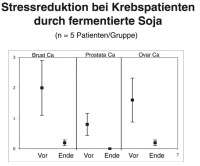
Stressreduktion von Krebspatienten durch fermentiertes Soja. Bewertung anhand von EORTC QLQ-C30 (Version 1). (0 = überhaupt
nicht, 3 = extrem) Keywords: Diagramm,
Gynäkologie,
Krebs,
Soja
|
|
|
28. Kunert M;
Gremmler B;
Konzen G;
Ulbricht LJ
Fallbericht: Angina pectoris bei Tachykardie-induzierter Obstruktion im linksventrikulären Ausflusstrakt
LVOT
Journal für Kardiologie - Austrian Journal of Cardiology 2008; 15 (7-8): 247-249
Doppler- Stress-Echokardiographie mit dynamischer Flussbeschleunigung im LVOT (Gradient 53 mmHg) unter High-dose-Dobutamin-Stimulation Keywords: Doppler-Echokardiographie,
Kardiologie,
LVOT
|
|
|
29. Espinola-Klein C;
Münzel T
Oxidativer Stress und Endothelfunktion: Welche Bedeutung hat das Geschlecht?
Endotheliale Dysfunktion
Blickpunkt der Mann 2008; 6 (4): 29-31
Mechanismus für die Induktion der endothelialen Dysfunktion durch oxidativen Stress. Mod. nach [6]. Keywords: Andrologie,
endotheliale Dysfunktion,
Oxidativer Stress,
Schema
|
|
|
30. Espinola-Klein C;
Münzel T
Oxidativer Stress und Endothelfunktion: Welche Bedeutung hat das Geschlecht?
NO-Synthetasen
Blickpunkt der Mann 2008; 6 (4): 29-31
Funktion und Form der NO-Synthetasen Keywords: Andrologie,
NO-Synthetasen,
Schema
|
|
|
31. Gasser R;
Ablasser K;
Roessl U;
Kraigher-Krainer E;
Lewinski D;
Mangge H;
Mächler H;
Trantina-Yates A;
Tscheliessnigg KH;
Udermann H;
Porta S;
Friehs I;
Scherr E;
Brussee H;
Gasser S
Differential Gene Expression und Nebivolol and Atenolol during Experimental Ischemia in Human Myocardium
Well-oxygenized preparations
Journal of Clinical and Basic Cardiology 2008; 11 (1-4): 16-23
In well-oxygenized preparations, we can see that numerous biochemical processes are up-regulated by nebivolol (not by atenolol). Interesting are reverse transcription, stress response, and protein phosphorylation. Keywords: biochemical process,
flowchart
|
|
|
32. Rensing L
Psychosozialer Streß und Herz-Kreislauf-Risiken: Neue Einsichten in komplexe Wirkmechanismen
Streßbeeinflußte Neurotransmitter
Blickpunkt der Mann 2007; 5 (1): 12-18
Überblick über einige streßbeeinflußte Neurotransmitter, Hormone und Signalsubstanzen, die den Blutdruck beeinflussen. Der Blutdruck wird wesentlich über die Herzleistung, die Gefäßweite,
vor allem der peripheren Gefäße, sowie über das Blutvolumen kontrolliert. Er wird außerdem durch ein neuronales Regelsystem reguliert (nicht dargestellt). ANP: Atrial Natriuretic Peptide; CRH:
Corticotropin-releasing Hormone; NA: Noradrenalin. Keywords: Andrologie,
Neurotransmitter,
Schema,
Stress
|
|
|
33. Rensing L
Psychosozialer Streß und Herz-Kreislauf-Risiken: Neue Einsichten in komplexe Wirkmechanismen
Streß - Arteriosklerose
Blickpunkt der Mann 2007; 5 (1): 12-18
Streßbeeinflußte wichtige Arteriosklerosefaktoren sowie weitere wichtige Einflußgrößen. ICAM-1: Intercellular Cell Adhesion Molecule 1; VCAM-1: Vascular Cell Adhesion Molecule 1 Keywords: Andrologie,
Arteriosklerose,
Schema,
Stress
|
|
|
|
|
|
35. Arck PC;
Knackstedt MK;
Blois SM
Current Insights and Future Perspectives on Neuro-Endocrine-Immune Circuity Challenging Pregnancy Maintenance and Fetal Health
Stress response
Journal für Reproduktionsmedizin und Endokrinologie - Journal of Reproductive Medicine and Endocrinology 2006; 3 (2): 98-102
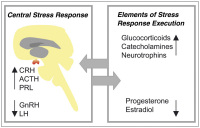
Central stress response and elements of stress response execution. In response to the perception of psychological stress, the central
stress reponse leads to the activation of the HPA axis, which causes the release of CRH, ACTH, and PRL and a down-regulation of GnRH
and LH. Peripheral elements of stress response execution are subsequently activated, including the glucocorticoids, catecholamines, and
neurotrophins. In mice, stress exposure has been shown to result in decrease of progesterone and possibly estradiol. CRH = corticotropinreleasing
hormone; ACTH = adrenocorticotropic hormone; PRL = prolactin; GnRH = gonadotropin-releasing hormone; LH = luteinising hormone;
HPA = hypothalamus-pituitary-adrenal. Keywords: Diagramm,
flowchart,
Stress,
stress response
|
|
|
36. Arck PC;
Knackstedt MK;
Blois SM
Current Insights and Future Perspectives on Neuro-Endocrine-Immune Circuity Challenging Pregnancy Maintenance and Fetal Health
Stress response
Journal für Reproduktionsmedizin und Endokrinologie - Journal of Reproductive Medicine and Endocrinology 2006; 3 (2): 98-102
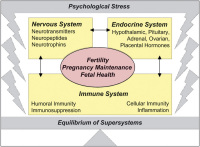
Principles of the stress response. The coordinated cross talk of the three supersystems (nervous, endocrine, and immune system) may
be challenged by psychological stress and ultimately affects fertility, pregnancy maintenance, and fetal health. Keywords: Diagramm,
fertility,
Fertilität,
flowchart,
Stress,
Stress
|
|
|
|
|
|
|
|
|
39. Strasser H;
Bartsch G;
Frauscher F;
Hering S;
Margreiter E;
Marksteiner R;
Mitterberger M;
Pinggera GM
Grundlagen der ultraschallgezielten transurethralen Stammzelltherapie der Harn-Inkontinenz
Transurethrale Sonographie
Journal für Urologie und Urogynäkologie 2005; 12 (4) (Ausgabe für Österreich): 28-30
Journal für Urologie und Urogynäkologie 2005; 12 (3) (Ausgabe für Deutschland): 27-29
Journal für Urologie und Urogynäkologie 2005; 12 (4) (Ausgabe für Schweiz): 29-31
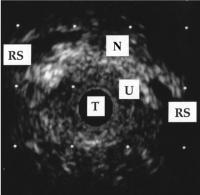
Transurethrale Sonographie eines Patienten mit Stress-Inkontinenz nach radikaler Prostatektomie. Der Rhabdosphinkter (RS) weist ventral eine Narbe (N) auf, sodaß die Kontraktilität des Muskels
deutlich reduziert ist (T = Ultraschall-Transducer, U = Urethra). Keywords: Prostatektomie,
Sonographie,
Stressinkontinenz,
Urologie
|
|
|
40. Porstmann J;
Arck PC
PIBF - Schlüssel zu einer erfolgreichen Schwangerschaft?
Streßhormon - CRH - ACTH
Journal für Fertilität und Reproduktion 2005; 15 (3) (Ausgabe für Österreich): 7-11
Journal für Fertilität und Reproduktion 2005; 15 (3) (Ausgabe für Schweiz): 5-8
Interaktion zwischen Stresshormonen und
Hormonen, die für Fertilität und Schwangerschaftserhalt
von Bedeutung sind. CRH wird im Hypothalamus gebildet und beeinflußt einerseits die Ausschüttung von ACTH aus dem Hypophysenvorderlappen und stimuliert die Freisetzung von Glukokortikoiden aus der Nebenniere, die negativ rückkoppelnd mit ACTH und CRH interagieren. Weiterhin hemmt CRH die Ausschüttung von "gonadotropin releasing hormon" (GnRH) aus dem Hypothalamus. Genau dieses Hormon ist aber für schwangerschaftsschützende Hormone (Progesteron – P, LH, Follikelstimulierendes Hormon – FSH) zuständig.
Diese hemmen, genau wie Glukokortikoide auch, die Produktion von Prostaglandin E2. Bei Streß erhöhen sich die Spiegel von CRH und Glukokortikoide werden hochreguliert und hemmen gleichzeitig Sexualhormone (GnRH, P, LH und FSH). Diese Inhibition beeinträchtigt
Fertilität und Schwangerschaftsverlauf. Keywords: ACTH,
CRH,
Schema,
Stresshormone
|
|
|
| |

 Suche Medizinische Publikationen
 Suche Abbildungen und Grafiken
 Medizinprodukte - Labortechnik
 Antidotarium (Stand 2012)
 Phytokodex (Stand 2012)
 Fachbücher
 Patientenliteratur