
 Suche Medizinische Publikationen
 Suche Abbildungen und Grafiken
 Medizinprodukte - Labortechnik
 Antidotarium (Stand 2012)
 Phytokodex (Stand 2012)
 Fachbücher
 Patientenliteratur
Jeremias A, Bertschat FL, Ising H, Jeremias E Possible correlation between decrease of ionized magnesium and calcium in blood to patient outcome after acute myocardial infarction Journal of Clinical and Basic Cardiology 2000; 3 (2): 123-128 PDF Summary Overview
| ||
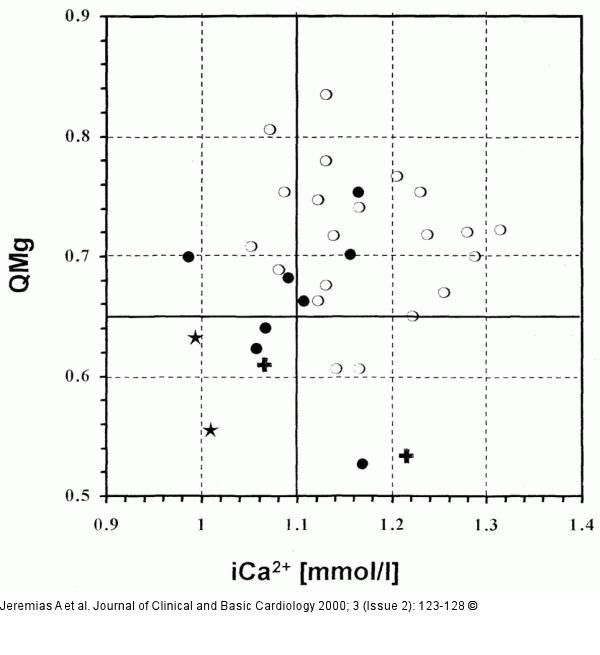
Figure/Graphic 1: Kardiovaskuläres Ereignis - Magnesium - Kalzium Relationship between the quotient of ionized and total plasma magnesium (QMg), ionized calcium values (iCa2+) and the frequency of major adverse cardiac events after acute myocardial infarction. Subjects included in the square defined by QMg < 0.65 and iCa2+ < 1.1 mmol/l had the highest complication rate. white dots = no complications; black dots = ventricular arrhythmia and/or congestive heart failure; asterisk = cardiopulmonary resuscitation; cross = death |

Figure/Graphic 1: Kardiovaskuläres Ereignis - Magnesium - Kalzium
Relationship between the quotient of ionized and total plasma magnesium (QMg), ionized calcium values (iCa2+) and the frequency of major adverse cardiac events after acute myocardial infarction. Subjects included in the square defined by QMg < 0.65 and iCa2+ < 1.1 mmol/l had the highest complication rate. white dots = no complications; black dots = ventricular arrhythmia and/or congestive heart failure; asterisk = cardiopulmonary resuscitation; cross = death |