Content-type: text/html Suchergebnis - Abbildungen und Graphiken
Krause und Pachernegg
Verlag für Medizin und Wirtschaft
Mobile Version
A-  |   A  |   A+
Werbung
 
Suchergebnis - Abbildungen und Graphiken
 
Alle Journale wurden nach Blois SM durchsucht Treffer 1 - 3 von 3

Medizinische Publikationen (1)  ::   Abbildungen und Graphiken  ::   Volltext (0)

Neue Suche:         Erweiterte Suche    Hilfe zur Suche

in allen Journalen nach  Bildtitel    Bildkeywords   Bildsummary   Autoren      Mindestens ein Wort  Alle Wörter   
1. Arck PC; Knackstedt MK; Blois SM
Current Insights and Future Perspectives on Neuro-Endocrine-Immune Circuity Challenging Pregnancy Maintenance and Fetal Health
Immunity´s adaption - Pregnancy
Journal für Reproduktionsmedizin und Endokrinologie - Journal of Reproductive Medicine and Endocrinology 2006; 3 (2): 98-102
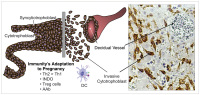
Immunity’s adaptation to pregnancy. Spatial adjacencies of invasive “histoincompatible” cytotrophoblast cells and maternal immune cells at the interface of fetal and maternal tissues guarantees nourishment of the fetus, but may provoke fetal rejection. Such spatial adjacencies are displayed on the left part of the figure, the right part reveals the in situ appearance in human deciduas basalis at gestation week 10, invasive trophoblast cells have been labelled by immunohistochemistry employing anti-cytokeratin antibody (magnification ×40). Tolerance mechanisms evolve in the process of immunity’s adaptation to pregnancy comprise the predominance of anti-inflammatory, Th2 cytokines over pro-inflammatory Th1 cytokines, the decidual expression of indoleamine 2, 3-dioxygenase (INDO), the presence of CD4+CD25bright regulatory T (Treg) cells, and the synthesis of asymmetric IgG antibodies (AAbs). In addition, it has become apparent in the past few years that dendritic cells (DCs) seem to be an essential regulatory cell subset at the feto-maternal interface in mediating tolerance.

Keywords: cytotrophoblasthistological examinationHistologisches PräparatSchemaschemeZytotrophoblast
2. Arck PC; Knackstedt MK; Blois SM
Current Insights and Future Perspectives on Neuro-Endocrine-Immune Circuity Challenging Pregnancy Maintenance and Fetal Health
Stress response
Journal für Reproduktionsmedizin und Endokrinologie - Journal of Reproductive Medicine and Endocrinology 2006; 3 (2): 98-102
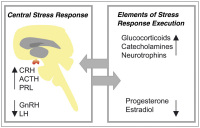
Central stress response and elements of stress response execution. In response to the perception of psychological stress, the central stress reponse leads to the activation of the HPA axis, which causes the release of CRH, ACTH, and PRL and a down-regulation of GnRH and LH. Peripheral elements of stress response execution are subsequently activated, including the glucocorticoids, catecholamines, and neurotrophins. In mice, stress exposure has been shown to result in decrease of progesterone and possibly estradiol. CRH = corticotropinreleasing hormone; ACTH = adrenocorticotropic hormone; PRL = prolactin; GnRH = gonadotropin-releasing hormone; LH = luteinising hormone; HPA = hypothalamus-pituitary-adrenal.

Keywords: DiagrammflowchartStressstress response
3. Arck PC; Knackstedt MK; Blois SM
Current Insights and Future Perspectives on Neuro-Endocrine-Immune Circuity Challenging Pregnancy Maintenance and Fetal Health
Stress response
Journal für Reproduktionsmedizin und Endokrinologie - Journal of Reproductive Medicine and Endocrinology 2006; 3 (2): 98-102
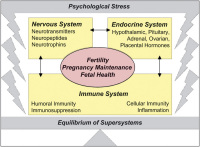
Principles of the stress response. The coordinated cross talk of the three supersystems (nervous, endocrine, and immune system) may be challenged by psychological stress and ultimately affects fertility, pregnancy maintenance, and fetal health.

Keywords: DiagrammfertilityFertilitätflowchartStressStress
 

 Seite 1 von 1 
 
copyright © 2000–2026 Krause & Pachernegg GmbH | Sitemap | Datenschutz | Impressum
 
Werbung