| Kopp AF et al. |
|---|
New Developments in Cardiac Imaging: The Role of MDCT
Journal of Clinical and Basic Cardiology 2001; 4 (4): 253-260
PDF Summary Figures
| Figure |
|---|
| |
|
|
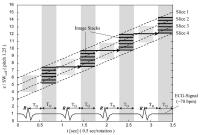
Computertomographie - Bildrekonstruktion
Figure 1: Reconstruction procedure with retrospectively ECG-gated 4-slice spiral scanning
Keywords: computer tomography,
Computertomographie,
Diagramm,
EKG,
electorcardiography,
Elektrokardiographie,
Reconstruction,
Rekonstruktion
|
| |
| |
|
|
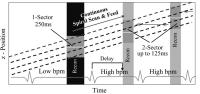
Computertomographie - Bildrekonstruktion
Figure 2: Retrospectively ECG-gated 4-slice spiral reconstruction with 1-sector reconstruction (black bar) for heart rates < 70 bpm and 2-sector reconstruction (2 grey bars are used for one reconstruction) for heart rates >= 70 bpm. The dashed lines indicate how the four detector rows travel along z-axis at a fixed speed (pitch). Using the adaptive approach gap-less volume reconstruction is possible with pitch 1.5 for all heart rates > 40 bpm.
Keywords: computer tomography,
Computertomographie,
Diagramm,
EKG,
electrocardiography,
Elektrokardiographie,
Reconstruction,
Rekonstruktion
|
| |
| |
|
|
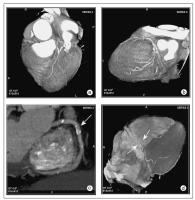
MDCT-Computertomographie
Figure 3a-d: MDCT angiography (collimation 4 x 1 mm, pitch 1.5, 120 cc Imeron(R) 400). (a) Anterior view of left coronary artery with LAD in volume rendering technique. (b) Lateral view of left coronary artery with LAD and circumflex branch. (c) Maximum intensity projection of right coronary artery with calcified plaques (arrow). (d) Diaphragmatic surface with posterolateral and interventricular
branches of RCA (arrows).
Keywords: Angiographie,
angiography,
Arteria circumflexa,
Arteria circumflexa,
Arteria coronaria dextra,
Arteria coronaria dextra,
computer tomography,
Computertomographie,
MDCT,
MDCT,
Ramus interventricularis anterior,
Ramus interventricularis anterior
|
| |
| |
|
|
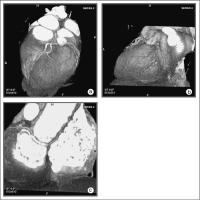
MCDT - Computertomographie
Figure 4a-c: Male 72-year old patient with known coronary anomaly (RCX originates from right coronary sinus) and absent CAD. Patient presented with recurrent chestpain. Stress-ECG up to 250 W showed no signs of ischaemia. (a) LAO cranial view in Volume Rendering mode. (b) "Left posterior oblique"-view depicts the small distal RCX. (c) View
from dorsal. Note the vessel caudal of the aortic bulb. The distal vessel is accompanied by a coronary vein, which runs cranial to the artery (arrow). Absence of signs indicating a stenotic CAD.
Keywords: Anomalie,
anomaly,
computer tomography,
Computertomographie,
MDCT,
MDCT,
Ramus circumflexus,
Ramus circumflexus,
Sinus coronarius,
Sinus coronarius
|
| |
| |
|
|
MDCT-Computertomographie
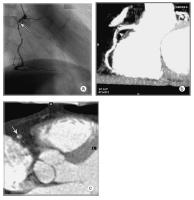
Figure 5a-c: Male patient, age 62, known 2-vessel-disease, s/p PTCA of proximal LAD. Patient presented with recurrent chest–pain and angina. (a) RAO-projection of conventional angiogram reveals high grade stenosis of descending RCA. (b) LAO projection of RCA by MDCT (collimation 4 x 1 mm, pitch 1.5, 120 cc Imeron(R) 400) depicts the proximal lesion as well as wall changes throughout the vessel. (c) Axial CT image of the mid-lesion region: the degree of stenosis is estimated to 80 % (arrow).
Keywords: Arteria coronaria dextra,
Arteria coronaria dextra,
computer tomography,
Computertomographie,
MDCT,
MDCT,
Stenose,
Stenosis,
two-vessel-disease,
Zweigefäßerkrankung
|
| |
| |
|
|
MDCT-Computertomographie
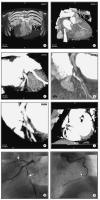
Figure 6a-h: Male patient, age 55, with "situs inversus" and 2-vessel-disease, s/p PTCA of proximal RCA and prox. LAD, a 60 % lesion of distal RCA was left untreated. (a) Anterior view (volume rendering mode) of thorax with ventral thorax wall cut away depicts situs inversus. (b) RAO projection of RCX and prominent marginal branch in volume rendering mode. No highgrade lesion can be readily appreciated. (c) MIP of RCX clearly shows a
lesion (arrow). The degree of stenosis is estimated at 70 %. (d) RAO cranial view of proximal LAD in volume rendering mode. The high-grade lesion
was not clearly delineated in this view. (e) MIP-image clearly depicted the lesion of the proximal LAD. (f) MIP of RCA in "left posterior oblique"-projection. The arrow depicts the distal RCA lesion. The black arrow shows the area of the former dilatation, no restenosis present. (g) LAO cranial
view of LAD and RCX with conventional angio. The arrows depict the lesions in each of the vessels. (h) RAO view of RCA by conventional angiography.
Note the progress of the former 60 % lesion to a high-grade lesion and the absent restenosis of the
proximal RCA.
Keywords: Arteria coronaria dextra,
Arteria coronaria dextra,
computer tomography,
Computertomographie,
MDCT,
MDCT,
Ramus circumflexus,
Ramus circumflexus,
Ramus interventricularis anterior,
Ramus interventricularis anterior,
Situs inversus,
Situs inversus,
two-vessel-disease,
Zweigefäßerkrankung
|
| |
| |
|
|
 Suche Medizinische Publikationen
 Suche Abbildungen und Grafiken
 Medizinprodukte - Labortechnik
 Antidotarium (Stand 2012)
 Phytokodex (Stand 2012)
 Fachbücher
 Patientenliteratur