
 Suche Medizinische Publikationen
 Suche Abbildungen und Grafiken
 Medizinprodukte - Labortechnik
 Antidotarium (Stand 2012)
 Phytokodex (Stand 2012)
 Fachbücher
 Patientenliteratur
Halestrap AP The Mitochondrial Permeability Transition - A Pore Way for the Heart to Die Journal of Clinical and Basic Cardiology 2002; 5 (1): 29-41 PDF Summary Overview
| ||||||||||||
Figure/Graphic 2: Mitochondrien - Apoptose The release of mitochondrial proteins plays a central role in the initiation of apoptosis. An apoptotic signal leads to the release of pro-apoptotic proteins located within the intermembrane space between the inner and outer mitochondrial membranes (IMM and OMM) into the cytosol. The pathway for release may be OMM rupture following opening of the MPTP and mitochondrial swelling, or through recruitment of specific pore-forming proteins to the outer membrane such as Bax and t-Bid. Release is inhibited by Bcl-2. The released cytochrome binds to Apaf-1 that proteolytically activates caspase 9 which in turn activates caspase 3 and so initiates the apoptotic cascade. Caspases are inhibited by endogenous inhibitors which are themselves inactivated by Smac (or DIABLO) that is also released along with apoptosis inducing factor (AIF). This migrates to the nucleus where it causes chromatin condensation and DNA fragmentation. Further details are given in the text. |


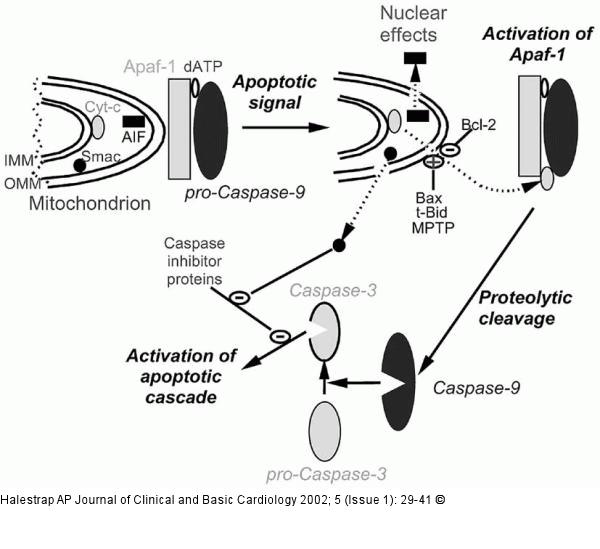
Figure/Graphic 2: Mitochondrien - Apoptose
The release of mitochondrial proteins plays a central role in the initiation of apoptosis. An apoptotic signal leads to the release of pro-apoptotic proteins located within the intermembrane space between the inner and outer mitochondrial membranes (IMM and OMM) into the cytosol. The pathway for release may be OMM rupture following opening of the MPTP and mitochondrial swelling, or through recruitment of specific pore-forming proteins to the outer membrane such as Bax and t-Bid. Release is inhibited by Bcl-2. The released cytochrome binds to Apaf-1 that proteolytically activates caspase 9 which in turn activates caspase 3 and so initiates the apoptotic cascade. Caspases are inhibited by endogenous inhibitors which are themselves inactivated by Smac (or DIABLO) that is also released along with apoptosis inducing factor (AIF). This migrates to the nucleus where it causes chromatin condensation and DNA fragmentation. Further details are given in the text. |