
 Suche Medizinische Publikationen
 Suche Abbildungen und Grafiken
 Medizinprodukte - Labortechnik
 Antidotarium (Stand 2012)
 Phytokodex (Stand 2012)
 Fachbücher
 Patientenliteratur
Auer J, Berent R, Eber B Homocysteine and Risk of Cardiovascular Disease Journal of Clinical and Basic Cardiology 2001; 4 (4): 261-264 PDF Summary Overview
| ||
Figure/Graphic 1: Homocystein - Metabolismus Pathways of homocysteine metabolism (CBS = cystathionine-beta-synthase; Cbl = cobalamin; THF1 = monoglutamated form of tetrahydrofolate; B6 = vitamin B6; CH3 = Methyl). Homocysteine is metabolized either by transsulfuration to cysteine (in a reaction catalyzed by cystathionine-beta-synthase [(CBS] with vitamin B6 as cofactor) or by remethylation to methionine. Remethylation is catalyzed by methionine synthase (and 5,10 methylenetetrahydrofolate reductase). Methionine synthase is dependent upon cobalamin (vitamin B12) as cofactor and folate as cosubstrate. An alternative remethylation pathway (not shown in the figure) uses the cobalamin independent betain-homocysteine methyltransferase. |

Figure/Graphic 1: Homocystein - Metabolismus
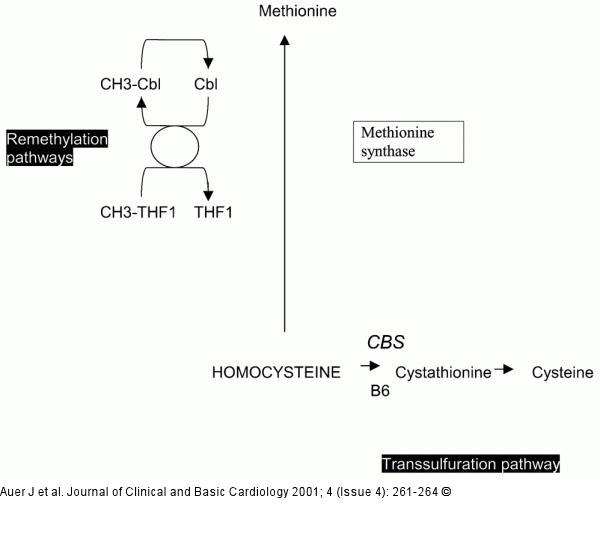
Pathways of homocysteine metabolism (CBS = cystathionine-beta-synthase; Cbl = cobalamin; THF1 = monoglutamated form of tetrahydrofolate; B6 = vitamin B6; CH3 = Methyl). Homocysteine is metabolized either by transsulfuration to cysteine (in a reaction catalyzed by cystathionine-beta-synthase [(CBS] with vitamin B6 as cofactor) or by remethylation to methionine. Remethylation is catalyzed by methionine synthase (and 5,10 methylenetetrahydrofolate reductase). Methionine synthase is dependent upon cobalamin (vitamin B12) as cofactor and folate as cosubstrate. An alternative remethylation pathway (not shown in the figure) uses the cobalamin independent betain-homocysteine methyltransferase. |