
 Suche Medizinische Publikationen
 Suche Abbildungen und Grafiken
 Medizinprodukte - Labortechnik
 Antidotarium (Stand 2012)
 Phytokodex (Stand 2012)
 Fachbücher
 Patientenliteratur
Salvadori A, Arreghini M, Bolla G, Fanari P, Giacomotti E, Longhini E, Miserocchi G, Palmulli P Cardiovascular and adrenergic response to exercise in obese subjects Journal of Clinical and Basic Cardiology 1999; 2 (2): 229-236 PDF Summary Overview
| ||||||||||||||||||
Figure/Graphic 7: Schlaganfall - Sauerstoffverbrauch - Adipositas Relationship of stroke volume vs. oxygen consumption (V·O2) in non-obese and obese subjects. The graph reports iso-workload lines. The regression was: Stroke Volume = 0.062 + 0.001 V·O2 - 0.003Z (R²: 0.53; F: 31; MSE: 0.001), with a dummy variable Z = 1 for the obese subjects and 0 for the non-obese subjects. The relationship relative to obese subjects displays statistically similar slopes and a lower intercept compared to controls (p < 0.01). |


Figure/Graphic 7: Schlaganfall - Sauerstoffverbrauch - Adipositas
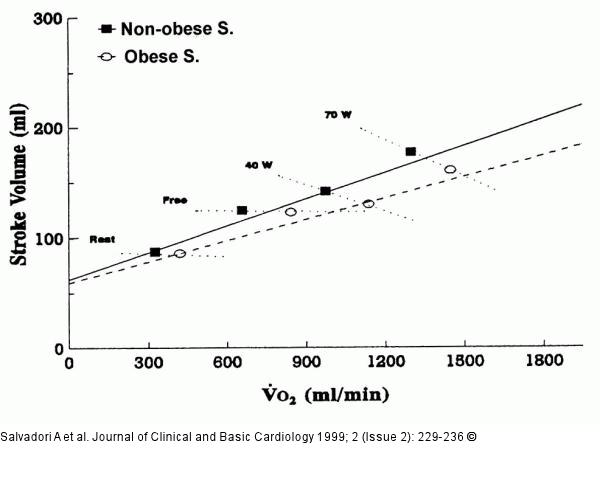
Relationship of stroke volume vs. oxygen consumption (V·O2) in non-obese and obese subjects. The graph reports iso-workload lines. The regression was: Stroke Volume = 0.062 + 0.001 V·O2 - 0.003Z (R²: 0.53; F: 31; MSE: 0.001), with a dummy variable Z = 1 for the obese subjects and 0 for the non-obese subjects. The relationship relative to obese subjects displays statistically similar slopes and a lower intercept compared to controls (p < 0.01). |