
 Suche Medizinische Publikationen
 Suche Abbildungen und Grafiken
 Medizinprodukte - Labortechnik
 Antidotarium (Stand 2012)
 Phytokodex (Stand 2012)
 Fachbücher
 Patientenliteratur
Dia-Präsentation von Merck Gesellschaft mbH. Micardis(R) - Micardis Plus(R) - Pharmakologie (14 Abbildungen) Übersicht
| ||||||||||||||||||
Abbildung 8: SBD - DBD The trough:peak ratio is a method for assessing the duration of effect of an antihypertensive.1 The mean 24-h ambulatory blood pressure is considered the gold standard for testing the duration of antihypertensive effect, although trough:peak ratios can still provide valuable guidance.2 Losartan provides a trough:peak ratio of 35% SBP and 51% DBP.3 Telmisartan once daily provides clinically significant reductions in trough (i.e., 24 h after last dose) SBP and DBP that are comparable to the peak reductions.4 The trough:peak ratio for the 40 mg dose is around 66% (SBP) and 100% (DBP), and around 92% (SBP) and 100% (DBP) for the 80-mg dose. 1. Joint National Committee on Prevention, Detection, Evaluation and Treatment of High Blood Pressure. The sixth report of the Joint National Committee on Prevention, Detection, Evaluation, and Treatment of High Blood Pressure. Arch Intern Med 1997; 157: 2413–2446. 2. International Conference on Harmonisation of Technical Requirements for Registration of Pharmaceuticals for Human Use. Principles for clinical evaluation of new antihypertensive drugs. 2000. Available at: http://www.fda.gov/cder/guidance/3774dft.htm 3. Stergiou GS, et al. Comparison of the smoothness index, the trough : peak ratio and the morning : evening ratio in assessing the features of the antihypertensive drug effect. J Hypertens 2003; 21: 913–920 4. Neutel JM. Ambulatory blood pressure monitoring to assess the comparative efficacy and duration of action of a novel new angiotensin II receptor blocker—telmisartan. Blood Press 2001; 10 (Suppl 4): 27–32. |


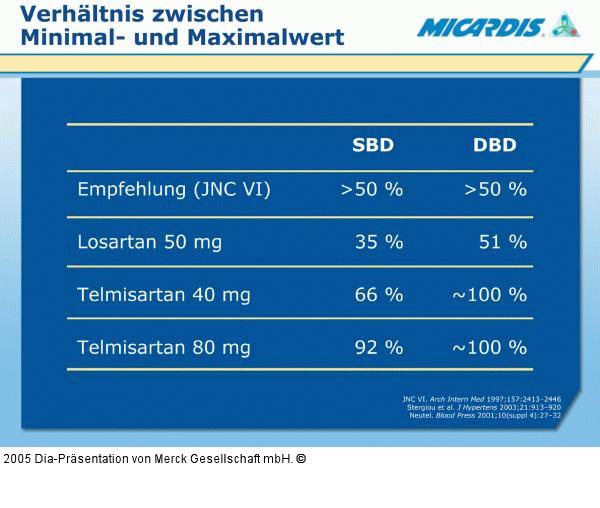
Abbildung 8: SBD - DBD
The trough:peak ratio is a method for assessing the duration of effect of an antihypertensive.1 The mean 24-h ambulatory blood pressure is considered the gold standard for testing the duration of antihypertensive effect, although trough:peak ratios can still provide valuable guidance.2 Losartan provides a trough:peak ratio of 35% SBP and 51% DBP.3 Telmisartan once daily provides clinically significant reductions in trough (i.e., 24 h after last dose) SBP and DBP that are comparable to the peak reductions.4 The trough:peak ratio for the 40 mg dose is around 66% (SBP) and 100% (DBP), and around 92% (SBP) and 100% (DBP) for the 80-mg dose. 1. Joint National Committee on Prevention, Detection, Evaluation and Treatment of High Blood Pressure. The sixth report of the Joint National Committee on Prevention, Detection, Evaluation, and Treatment of High Blood Pressure. Arch Intern Med 1997; 157: 2413–2446. 2. International Conference on Harmonisation of Technical Requirements for Registration of Pharmaceuticals for Human Use. Principles for clinical evaluation of new antihypertensive drugs. 2000. Available at: http://www.fda.gov/cder/guidance/3774dft.htm 3. Stergiou GS, et al. Comparison of the smoothness index, the trough : peak ratio and the morning : evening ratio in assessing the features of the antihypertensive drug effect. J Hypertens 2003; 21: 913–920 4. Neutel JM. Ambulatory blood pressure monitoring to assess the comparative efficacy and duration of action of a novel new angiotensin II receptor blocker—telmisartan. Blood Press 2001; 10 (Suppl 4): 27–32. |