
 Suche Medizinische Publikationen
 Suche Abbildungen und Grafiken
 Medizinprodukte - Labortechnik
 Antidotarium (Stand 2012)
 Phytokodex (Stand 2012)
 Fachbücher
 Patientenliteratur
Dia-Präsentation von SERVIER EUROPA-Studie (Perindopril) (60 Abbildungen) Übersicht Gesamtpräsentation zum Download (rechte Maustaste und "Ziel speichern unter..." klicken)
| ||||||||||||||||||
Abbildung 7: Endotheliale Dysfunktion As the dysfunctional endothelium progresses from early to more mature stages of atherosclerotic lesions, abnormal activity within the blood vessel continues: A fatty streak is formed within the vessel wall (lipid accumulation). Later, smooth muscle cells begin to migrate into the developing plaque. Leukocytes continue to adhere to the endothelium and after penetration move into the vessel wall. Inflammatory response in the atherosclerotic lesion starts. Platelets adhere to the dysfunctional endothelium contributing to the migration and proliferation of smooth muscle cells and monocytes, but also to platelet aggregation. Platelets accumulating on the vessel wall contribute to thrombus formation. As the atherosclerotic plaque progresses to late stages, a fibrous cap forms over the plaque and walls of the lesion from the vessel lumen. This fibrous cap may then become unstable and rupture causing thrombus formation, and often, CV events. |


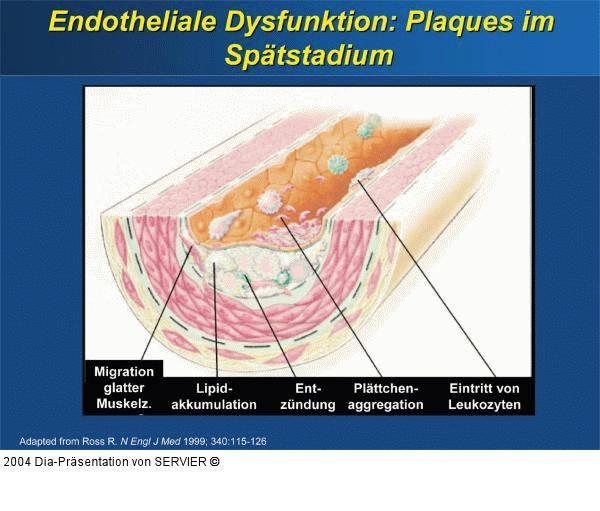
Abbildung 7: Endotheliale Dysfunktion
As the dysfunctional endothelium progresses from early to more mature stages of atherosclerotic lesions, abnormal activity within the blood vessel continues: A fatty streak is formed within the vessel wall (lipid accumulation). Later, smooth muscle cells begin to migrate into the developing plaque. Leukocytes continue to adhere to the endothelium and after penetration move into the vessel wall. Inflammatory response in the atherosclerotic lesion starts. Platelets adhere to the dysfunctional endothelium contributing to the migration and proliferation of smooth muscle cells and monocytes, but also to platelet aggregation. Platelets accumulating on the vessel wall contribute to thrombus formation. As the atherosclerotic plaque progresses to late stages, a fibrous cap forms over the plaque and walls of the lesion from the vessel lumen. This fibrous cap may then become unstable and rupture causing thrombus formation, and often, CV events. |