| |
| Alle Journale wurden nach Pieske B durchsucht |
Treffer 1 - 19 von 19 |
|
|
|---|
1. Schmidt AG;
Pieske B
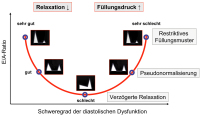
Die diastolische Herzinsuffizienz - Pathophysiologische Grundlagen, diagnostische Strategien, therapeutische Optionen
Transmitrales Einstromprofil
Journal für Kardiologie - Austrian Journal of Cardiology 2012; 19 (5-6): 107-117
Stadienabhängige Änderung des transmitralen Einstromprofils in
Abhängigkeit vom Schweregrad der diastolischen Funktionsstörung. Problem der Uförmigen
Beziehung des transmitralen Einstromprofils bei diastolischer Dysfunktion.
Bei Fortschreiten der diastolischen Funktionsstörung kommt es zu einer Pseudonormalisierung
des transmitralen Einstromprofils, das in vielen Aspekten dem normalen
Füllungsmuster ähnelt. Keywords: Einstromprofil,
Kardiologie,
Schema
|
|
|
2. Schmidt AG;
Pieske B
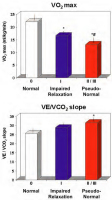
Die diastolische Herzinsuffizienz - Pathophysiologische Grundlagen, diagnostische Strategien, therapeutische Optionen
Körperliche Belastbarkeit
Journal für Kardiologie - Austrian Journal of Cardiology 2012; 19 (5-6): 107-117
Einschränkung der körperliche Belastbarkeit bei diastolischer Dysfunktion
und HFnEF. Stadienabhängige Reduktion der körperlichen Belastbarkeit bei Patienten
mit diastolischer Dysfunktion und HFnEF. Deutliche Abnahme der maximalen
Sauerstoffaufnahmekapazität (VO2 max) und Verschlechterung der ventilatorischen
Effizienz (VE/VCO2 slope) bei Patienten mit fortgeschrittener diastolischer Dysfunktion,
die mit den Werten von Patienten mit schwerer systolischer Herzinsuffizienz
vergleichbar sind. Mod. nach [30]. Keywords: Diagramm,
diastolische Dysfunktion,
HFnEF,
Kardiologie,
körperliche Belastbarkeit
|
|
|
3. Schmidt AG;
Pieske B
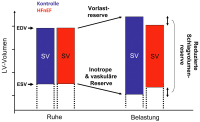
Die diastolische Herzinsuffizienz - Pathophysiologische Grundlagen, diagnostische Strategien, therapeutische Optionen
Schlag-Volumen-Reserve
Journal für Kardiologie - Austrian Journal of Cardiology 2012; 19 (5-6): 107-117
Einschränkung der Schlag-Volumen-Reserve unter Belastung. Die Schlag-Volumen-Reserve unter Belastung ist bei DHF/HFpEF-Patienten signifikant
eingeschränkt und beruht wahrscheinlich auf einer Kombination von diastolischer,
systolischer und vasodilatorischer Dysfunktion. Mod. nach [1]. Keywords: Kardiologie,
Schlag-Volumen-Reserve
|
|
|
4. Schmidt AG;
Pieske B
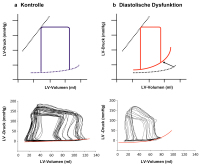
Die diastolische Herzinsuffizienz - Pathophysiologische Grundlagen, diagnostische Strategien, therapeutische Optionen
Druck-Volumen-Kurve
Journal für Kardiologie - Austrian Journal of Cardiology 2012; 19 (5-6): 107-117
Linksventrikuläre Druck-Volumen-Kurven bei normaler LV-Funktion und diastolischer Dysfunktion. Typische Druck-Volumen-Kurven während transienter Vorlastreduktion
mittels eines Vena-cava-Okklusions-Ballons. (a): Proband mit normaler LV-Funktion (Kontrolle); (b): Patient mit HFnEF. Es besteht eine diastolische Dysfunktion:
Die enddiastolischen Druck-Volumenkurve ist nach links und oben verschoben, der enddiastolische Druck ist erhöht. Mod. nach [12]. Keywords: Druck-Volumen-Kurve,
Kardiologie
|
|
|
5. Schmidt AG;
Pieske B
Die diastolische Herzinsuffizienz - Pathophysiologische Grundlagen, diagnostische Strategien, therapeutische Optionen
Diastolische HI - Prognose - Todesursachen
Journal für Kardiologie - Austrian Journal of Cardiology 2012; 19 (5-6): 107-117
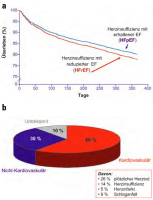
Prognose und Todesursachen der diastolischen Herzinsuffizienz. (a):
Überlebenskurven für Patienten mit Herzinsuffizienz und erhaltener oder reduzierter
Ejektionsfraktion über den Zeitraum von 1 Jahr nach erstmaliger Hospitalisierung.
Die adjustierte Mortalitätsrate war dabei für die Gruppe der Patienten mit reduzierter
EF nicht sign. höher als die der Patienten mit erhaltener EF. Mod. nach [4]; (b):
Prozentuale Verteilung der Todesursachen für Patienten mit HFpEF im I-Preserve-
Trial: 60 % kardiovaskulär (26 % plötzlicher Herztod, 14 % Herzinsuffizienz, 5 %
Myokardinfarkt, 9 % Schlaganfall, 6 % kardiovaskuläre Prozeduren und andere kardiovaskuläre
Ursachen), 30 % nicht-kardiovaskulär, 10 % unbekannt. Mod. nach [8]. Keywords: Diagramm,
Herzinsuffizienz,
Kardiologie
|
|
|
6. Schmidt AG;
Pieske B
Die diastolische Herzinsuffizienz - Pathophysiologische Grundlagen, diagnostische Strategien, therapeutische Optionen
Diastolische HI
Journal für Kardiologie - Austrian Journal of Cardiology 2012; 19 (5-6): 107-117
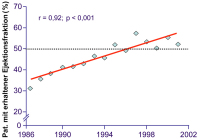
Prävalenz der diastolischen Herzinsuffizienz. In über 50 % der Herzinsuffizienzfälle
liegt eine diastolische Herzinsuffizienz vor, die Prävalenz der Herzinsuffizienz
mit erhaltener EF (HFpEF) steigt relativ zur Herzinsuffizienz mit reduzierter
EF (HFrEF). Mod. nach [3]. Keywords: Diagramm,
Herzinsuffizienz,
Kardiologie
|
|
|
7. Gasser R;
Pätzold S;
Holzwart E;
Ablasser K;
Kraigher-Krainer E;
Friehs I;
Lewinski D;
Pieske B;
Mächler H;
Trantiner-Yates A;
Tscheliessnig KH;
Mangge H;
Porta S;
Gasser S
Immunological Implications in Experimental Myocardial Ischaemia: MPO (Myeloperoxidase) Expression Is Differentially Regulated by Beta-Blockers, While CD80 Expression Remains Unaffected
CD80 Experiments
Journal of Clinical and Basic Cardiology 2011; 14 (1-4): 16-22
It shows the results from real-time PCR measurements of
all CD80 experiments (o2ko: well-oxygenated, no ischaemia, no
drug; n2ko: experimental ischaemia, no drug; o2at: well-oxygenated,
no ischaemia, atenolol present; n2at: experimental ischaemia,
atenolol present; o2neb: well-oxygenated, nebivolol present; n2neb:
experimental ischaemia, nebivolol present). It can be seen that during
experimental ischaemia, there is an up-regulation of CD80 expression.
There is also a regulation with and without the influence of
beta-blockers during myocardial ischaemia. Keywords: CD80,
flowchart
|
|
|
8. Gasser R;
Pätzold S;
Holzwart E;
Ablasser K;
Kraigher-Krainer E;
Friehs I;
Lewinski D;
Pieske B;
Mächler H;
Trantiner-Yates A;
Tscheliessnig KH;
Mangge H;
Porta S;
Gasser S
Immunological Implications in Experimental Myocardial Ischaemia: MPO (Myeloperoxidase) Expression Is Differentially Regulated by Beta-Blockers, While CD80 Expression Remains Unaffected
Interleukin Pathway
Journal of Clinical and Basic Cardiology 2011; 14 (1-4): 16-22
Interleukin pathway up-regulated by nebivolol, not by
atenolol, during experimental ischaemia. Keywords: flowchart,
interleukin
|
|
|
9. Gasser R;
Pätzold S;
Holzwart E;
Ablasser K;
Kraigher-Krainer E;
Friehs I;
Lewinski D;
Pieske B;
Mächler H;
Trantiner-Yates A;
Tscheliessnig KH;
Mangge H;
Porta S;
Gasser S
Immunological Implications in Experimental Myocardial Ischaemia: MPO (Myeloperoxidase) Expression Is Differentially Regulated by Beta-Blockers, While CD80 Expression Remains Unaffected
MPO Experiments
Journal of Clinical and Basic Cardiology 2011; 14 (1-4): 16-22
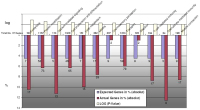
It shows the results from real-time PCR measurements of
all MPO experiments (o2ko: well-oxygenated, no ischaemia, no
drug; n2ko: experimental ischaemia, no drug; o2at: well-oxygenated,
no ischaemia, atenolol present; n2at: experimental ischaemia,
atenolol present; o2neb: well-oxygenated, nebivolol present; n2neb:
experimental ischaemia, nebivolol present). Using PCR for validation,
we find that during experimental ischaemia, there is an up-regulation
of MPO expression. There is a differential regulation between
different beta-blockers during myocardial ischaemia, which warrants
further investigation. Keywords: flowchart,
MPO
|
|
|
10. Holzwart E;
Gasser S;
Roessl U;
Buehner A;
Ablasser K;
Friehs I;
Pieske B;
Mächler H;
Yates A;
Tscheliessnig KH;
Mangge H;
Porta S;
Gasser R
Effect of Betablockers on the Regulation of PDK (Pyruvate Dehydrogenase Kinase) Gene Expression in Both Normoxic and Hypoxic Myocardium
PCR - PDK
Journal of Clinical and Basic Cardiology 2010; 13 (1-4): 12-18
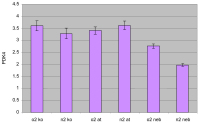
The results from real-time
PCR measurements of PDK experiments
are illustrated (o2ko: well-oxygenated,
no ischemia, no drug; n2ko:
experimental ischemia, no drug; o2at:
well-oxygenated, no ischemia, atenolol
present; n2at: experimental ischemia,
atenolol present; o2neb: well-oxygenated,
nebivolol present; n2neb: experimental
ischemia, nebivolol present). It
can be seen that, without the influence
of betablockers, there is no significant
regulation of PDK expression during
myocardial ischemia. There is just a
trend towards a decrease in PDK gene
expression. There is, however, a significant
difference between the expression
of PDK during myocardial ischemia in
the presence of atenolol (3.62 ± 0. 18)
and nebivolol (1.97 ± 0.06; ± SEM;
P ≤ 0.05): PDK expression is decreased
during normoxia (trend) and ischemia
(significant) in the presence of nebivolol. Keywords: flowchart,
PCR,
PDK
|
|
|
11. Holzwart E;
Gasser S;
Roessl U;
Buehner A;
Ablasser K;
Friehs I;
Pieske B;
Mächler H;
Yates A;
Tscheliessnig KH;
Mangge H;
Porta S;
Gasser R
Effect of Betablockers on the Regulation of PDK (Pyruvate Dehydrogenase Kinase) Gene Expression in Both Normoxic and Hypoxic Myocardium
PDK
Journal of Clinical and Basic Cardiology 2010; 13 (1-4): 12-18
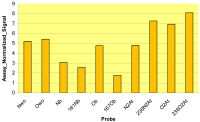
In this figure, the results from
microarray measurements of PDK experiments
are illustrated. Pooled DNA data:
Control experiments: Owo: pool control,
well-oxygenated, no ischemia, no drug;
Nwo: pool experimental ischemia, no drug;
Atenolol experiments: O2At: pool welloxygenated,
no ischemia, atenolol present;
N2At: pool experimental ischemia, atenolol
present; Nebivolol experiments: Ob: pool
well-oxygenated, nebivolol present; Nb:
pool experimental ischemia, nebivolol
present. It can be seen that, without the influence
of betablockers, there is no significant
regulation of PDK expression during
myocardial ischemia. While there is no
down-regulation of PDK gene expression
by atenolol, there is a decrease in PDK gene
expression in the presence of nebivolol
both during normoxia and hypoxia. 167Nb,
167Ob, 236N2At and 236O2At are corresponding
single-experiment controls. Keywords: flowchart,
PDK
|
|
|
12. Holzwart E;
Gasser S;
Roessl U;
Buehner A;
Ablasser K;
Friehs I;
Pieske B;
Mächler H;
Yates A;
Tscheliessnig KH;
Mangge H;
Porta S;
Gasser R
Effect of Betablockers on the Regulation of PDK (Pyruvate Dehydrogenase Kinase) Gene Expression in Both Normoxic and Hypoxic Myocardium
Gene expression
Journal of Clinical and Basic Cardiology 2010; 13 (1-4): 12-18
Gene expression of biological processes associated with
glucose metabolism during normoxia and hypoxia is down-regulated
in human atrial tissue. Up-regulation of gene-expression associated
with glucose metabolism during hypoxia. Keywords: flowchart,
gene expression
|
|
|
13. Holzwart E;
Gasser S;
Roessl U;
Buehner A;
Ablasser K;
Friehs I;
Pieske B;
Mächler H;
Yates A;
Tscheliessnig KH;
Mangge H;
Porta S;
Gasser R
Effect of Betablockers on the Regulation of PDK (Pyruvate Dehydrogenase Kinase) Gene Expression in Both Normoxic and Hypoxic Myocardium
Gene expression
Journal of Clinical and Basic Cardiology 2010; 13 (1-4): 12-18
Example of differential regulation of gene expression by atenolol and nebivolol in well-oxygenized preparations: one can see that
numerous biochemical processes are affected by nebivolol but not by atenolol. For example, many processes involved in contraction, lipid
metabolism, and proliferation are down-regulated by nebivolol only (not by atenolol). Reducing lipid metabolism in exchange for an increased
carbohydrate metabolism may render the heart less vulnerable to O2 deficit or ischemia. Keywords: flowchart,
gene expression
|
|
|
14. Gasser R;
Roessl U;
Holzwart E;
Ablasser K;
Friehs I;
Lewinski D;
Pieske B;
Mächler H;
Trantiner-Yates A;
Tscheliessnig KH;
Mangge H;
Gasser S
Shift from Adult to Fetal Metabolic Phenotype During Prolonged Experimental Myocardial Ischemia: A Study on the Effect of Beta Blockers upon Gene Expression of Transmembrane Glucose Transporters
Myocardial Metabolism
Journal of Clinical and Basic Cardiology 2009; 12 (1-4): 11-17
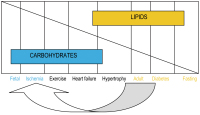
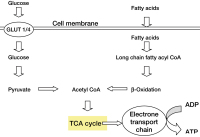
Plasticity of myocardial metabolism: during exercise, hypoxia/
ischemia etc myocardial cells prefer glucose as a substrate. Both
fasting and diabetes shift the metabolic substrates to the fatty acid
site. Mod. from [29, 33]. Keywords: chart,
Diagramm
|
|
|
15. Gasser R;
Roessl U;
Holzwart E;
Ablasser K;
Friehs I;
Lewinski D;
Pieske B;
Mächler H;
Trantiner-Yates A;
Tscheliessnig KH;
Mangge H;
Gasser S
Shift from Adult to Fetal Metabolic Phenotype During Prolonged Experimental Myocardial Ischemia: A Study on the Effect of Beta Blockers upon Gene Expression of Transmembrane Glucose Transporters
Cardiac metabolism
Journal of Clinical and Basic Cardiology 2009; 12 (1-4): 11-17
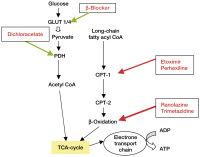
Shifting cardiac metabolism to its fetal phenotype: as an
anti-anginal target (mod. from [32]) of dichloracetate augments cellular
glucose metabolism. Etoximir and perhexiline inhibit cellular
fatty acid metabolism and both ranolazine as well as trimetazidine
slow down beta oxidation. Beta-adrenergic blockade enhances
GLUT1 and GLUT4 expressions. Keywords: Schema,
scheme
|
|
|
16. Gasser R;
Roessl U;
Holzwart E;
Ablasser K;
Friehs I;
Lewinski D;
Pieske B;
Mächler H;
Trantiner-Yates A;
Tscheliessnig KH;
Mangge H;
Gasser S
Shift from Adult to Fetal Metabolic Phenotype During Prolonged Experimental Myocardial Ischemia: A Study on the Effect of Beta Blockers upon Gene Expression of Transmembrane Glucose Transporters
Glucose metabolism
Journal of Clinical and Basic Cardiology 2009; 12 (1-4): 11-17
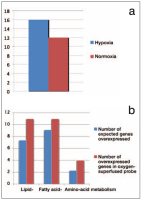
(a) Gene expression of biological processes associated
with glucose metabolism during normoxia and hypoxia. Up-regulation of glucose metabolism. (b) Down-regulation of gene expression of biological processes associated with fatty acid and amino acid
metabolism – (a) and (b) indicate a conversion to the fetal type of metabolism. Based on data from [4–9, 32–35]. Keywords: chart,
Diagramm
|
|
|
17. Gasser R;
Roessl U;
Holzwart E;
Ablasser K;
Friehs I;
Lewinski D;
Pieske B;
Mächler H;
Trantiner-Yates A;
Tscheliessnig KH;
Mangge H;
Gasser S
Shift from Adult to Fetal Metabolic Phenotype During Prolonged Experimental Myocardial Ischemia: A Study on the Effect of Beta Blockers upon Gene Expression of Transmembrane Glucose Transporters
Myocardial Metabolism
Journal of Clinical and Basic Cardiology 2009; 12 (1-4): 11-17
Substrates of myocardial metabolism. Mod. from [29, 32]. The fetal myocardial phenotype uses predominantly glucose for its
metabolism, whereas the adult individual mainly metabolises fatty
acids. During special conditions, like hypoxia, the adult phenotype of
myocardial metabolism converts to the fetal phenotype, again preferably
using glucose for its metabolism (Fig. 4). It has been shown
that a preferentially glucose-oriented cardiac metabolism is beneficial
in myocardial ischemia. However, knockout experiments have
shown that successful transfer to the fetal metabolism is possible
only under adequate/increased GLUT1 expression [33–35]. Keywords: chart,
Diagramm
|
|
|
18. Gasser R;
Roessl U;
Holzwart E;
Ablasser K;
Friehs I;
Lewinski D;
Pieske B;
Mächler H;
Trantiner-Yates A;
Tscheliessnig KH;
Mangge H;
Gasser S
Shift from Adult to Fetal Metabolic Phenotype During Prolonged Experimental Myocardial Ischemia: A Study on the Effect of Beta Blockers upon Gene Expression of Transmembrane Glucose Transporters
Real-time PCR
Journal of Clinical and Basic Cardiology 2009; 12 (1-4): 11-17
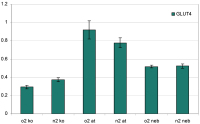
Results from real-time PCR measurements of all GLUT4
experiments (o2ko = well-oxygenated, no ischemia, no drug; n2ko =
experimental ischemia, no drug; o2at = well-oxygenated, no ischemia,
atenolol present; n2at = experimental ischemia, atenolol present;
o2neb = well-oxygenated, nebivolol present; n2neb = experimental
ischemia, nebivolol present). It can be seen that during experimental
ischemia, there is an up-regulation of GLUT4 (SLC2A4) expression,
however not statistically significant. Keywords: chart,
Diagramm
|
|
|
19. Gasser R;
Roessl U;
Holzwart E;
Ablasser K;
Friehs I;
Lewinski D;
Pieske B;
Mächler H;
Trantiner-Yates A;
Tscheliessnig KH;
Mangge H;
Gasser S
Shift from Adult to Fetal Metabolic Phenotype During Prolonged Experimental Myocardial Ischemia: A Study on the Effect of Beta Blockers upon Gene Expression of Transmembrane Glucose Transporters
Real-time PCR
Journal of Clinical and Basic Cardiology 2009; 12 (1-4): 11-17
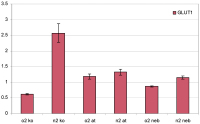
Results from real-time PCR measurements of 72 experiments (n = 12 in each group; o2ko = well-oxygenated, no ischemia,
no drug; n2ko = experimental ischemia, no drug; o2at = well-oxygenated,
no ischemia, atenolol present; n2at = experimental ischemia,
atenolol present; o2neb = well-oxygenated, nebivolol present;
n2neb = experimental ischemia, nebivolol present). It can be seen
that during experimental ischemia, there is an up-regulation of
GLUT1 expression, however, not statistically significant. This confirms
earlier data by our group. While there is no significant regulation
with and without the influence of beta blockers during myocardial
ischemia either, there is, however, a significant difference between
the expression of GLUT1 in well-oxygenized preparations with
(0.87 ± 0.02) and without nebivolol (0.62 ± 0.02; ± SEM; p ≤ 0.05).
Similarly, atenolol led to an increase of GLUT1 expression in welloxygenated
preparations compared to controls: 1.18 ± 0.08 and
0.62 ± 0.02, respectively (+ SEM; p < 0.05) Keywords: chart,
Diagramm
|
|
|
| |
|

 Suche Medizinische Publikationen
 Suche Abbildungen und Grafiken
 Medizinprodukte - Labortechnik
 Antidotarium (Stand 2012)
 Phytokodex (Stand 2012)
 Fachbücher
 Patientenliteratur