
 Suche Medizinische Publikationen
 Suche Abbildungen und Grafiken
 Medizinprodukte - Labortechnik
 Antidotarium (Stand 2012)
 Phytokodex (Stand 2012)
 Fachbücher
 Patientenliteratur
Smits M Functional Magnetic Resonance Imaging (fMRI) in Brain Tumour Patients European Association of NeuroOncology Magazine 2012; 2 (3): 123-128 PDF Summary Overview
| ||||||||
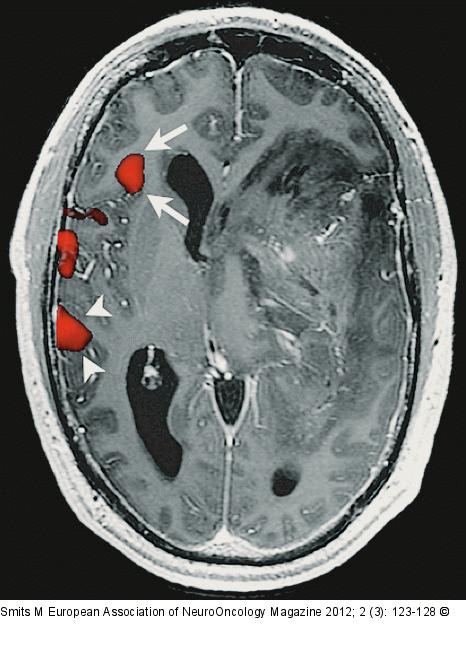
Figure/Graphic 3: Brain tumour Large high-grade tumour in the left temporal lobe of a right-handed patient. fMRI activation of a verb generation task is present in the expressive-language area in the inferior frontal gyrus (arrows), as well as in the receptive-language areas in the posterior temporo-parietal cortex (arrowheads) in the right hemisphere. No activation is seen in the left hemisphere. Upon surgery, a left-lateralised hemispheric language representation was found with ECM, as would be expected in a right-handed patient. The atypical lateralisation towards the right hemisphere found with fMRI is most likely due to a tumour (mass) effect decreasing the BOLD signal in the affected left hemisphere. |


Figure/Graphic 3: Brain tumour
Large high-grade tumour in the left temporal lobe of a right-handed patient. fMRI activation of a verb generation task is present in the expressive-language area in the inferior frontal gyrus (arrows), as well as in the receptive-language areas in the posterior temporo-parietal cortex (arrowheads) in the right hemisphere. No activation is seen in the left hemisphere. Upon surgery, a left-lateralised hemispheric language representation was found with ECM, as would be expected in a right-handed patient. The atypical lateralisation towards the right hemisphere found with fMRI is most likely due to a tumour (mass) effect decreasing the BOLD signal in the affected left hemisphere. |