| |
| Alle Journale wurden nach Arck PC durchsucht |
Treffer 1 - 5 von 5 |
|
|
|---|
1. Arck PC;
Knackstedt MK;
Blois SM
Current Insights and Future Perspectives on Neuro-Endocrine-Immune Circuity Challenging Pregnancy Maintenance and Fetal Health
Immunity´s adaption - Pregnancy
Journal für Reproduktionsmedizin und Endokrinologie - Journal of Reproductive Medicine and Endocrinology 2006; 3 (2): 98-102
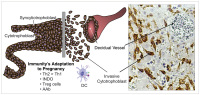
Immunity’s adaptation to pregnancy. Spatial adjacencies of invasive “histoincompatible� cytotrophoblast cells and maternal immune
cells at the interface of fetal and maternal tissues guarantees nourishment of the fetus, but may provoke fetal rejection. Such spatial adjacencies are displayed on the left part of the figure, the right part reveals the in situ appearance in human deciduas basalis at gestation week 10, invasive
trophoblast cells have been labelled by immunohistochemistry employing anti-cytokeratin antibody (magnification ×40). Tolerance mechanisms evolve in the process of immunity’s adaptation to pregnancy comprise the predominance of anti-inflammatory, Th2 cytokines over pro-inflammatory Th1 cytokines, the decidual expression of indoleamine 2, 3-dioxygenase (INDO), the presence of CD4+CD25bright regulatory T (Treg) cells, and the synthesis of asymmetric IgG antibodies (AAbs). In addition, it has become apparent in the past few years that dendritic cells (DCs) seem to be an essential regulatory cell subset at the feto-maternal interface in mediating tolerance. Keywords: cytotrophoblast,
histological examination,
Histologisches Präparat,
Schema,
scheme,
Zytotrophoblast
|
|
|
2. Arck PC;
Knackstedt MK;
Blois SM
Current Insights and Future Perspectives on Neuro-Endocrine-Immune Circuity Challenging Pregnancy Maintenance and Fetal Health
Stress response
Journal für Reproduktionsmedizin und Endokrinologie - Journal of Reproductive Medicine and Endocrinology 2006; 3 (2): 98-102
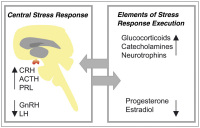
Central stress response and elements of stress response execution. In response to the perception of psychological stress, the central
stress reponse leads to the activation of the HPA axis, which causes the release of CRH, ACTH, and PRL and a down-regulation of GnRH
and LH. Peripheral elements of stress response execution are subsequently activated, including the glucocorticoids, catecholamines, and
neurotrophins. In mice, stress exposure has been shown to result in decrease of progesterone and possibly estradiol. CRH = corticotropinreleasing
hormone; ACTH = adrenocorticotropic hormone; PRL = prolactin; GnRH = gonadotropin-releasing hormone; LH = luteinising hormone;
HPA = hypothalamus-pituitary-adrenal. Keywords: Diagramm,
flowchart,
Stress,
stress response
|
|
|
3. Arck PC;
Knackstedt MK;
Blois SM
Current Insights and Future Perspectives on Neuro-Endocrine-Immune Circuity Challenging Pregnancy Maintenance and Fetal Health
Stress response
Journal für Reproduktionsmedizin und Endokrinologie - Journal of Reproductive Medicine and Endocrinology 2006; 3 (2): 98-102
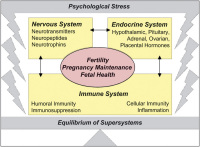
Principles of the stress response. The coordinated cross talk of the three supersystems (nervous, endocrine, and immune system) may
be challenged by psychological stress and ultimately affects fertility, pregnancy maintenance, and fetal health. Keywords: Diagramm,
fertility,
Fertilität,
flowchart,
Stress,
Stress
|
|
|
4. Porstmann J;
Arck PC
PIBF - Schlüssel zu einer erfolgreichen Schwangerschaft?
Streßhormon - CRH - ACTH
Journal für Fertilität und Reproduktion 2005; 15 (3) (Ausgabe für Österreich): 7-11
Journal für Fertilität und Reproduktion 2005; 15 (3) (Ausgabe für Schweiz): 5-8
Interaktion zwischen Stresshormonen und
Hormonen, die für Fertilität und Schwangerschaftserhalt
von Bedeutung sind. CRH wird im Hypothalamus gebildet und beeinflußt einerseits die Ausschüttung von ACTH aus dem Hypophysenvorderlappen und stimuliert die Freisetzung von Glukokortikoiden aus der Nebenniere, die negativ rückkoppelnd mit ACTH und CRH interagieren. Weiterhin hemmt CRH die Ausschüttung von "gonadotropin releasing hormon" (GnRH) aus dem Hypothalamus. Genau dieses Hormon ist aber für schwangerschaftsschützende Hormone (Progesteron – P, LH, Follikelstimulierendes Hormon – FSH) zuständig.
Diese hemmen, genau wie Glukokortikoide auch, die Produktion von Prostaglandin E2. Bei Streß erhöhen sich die Spiegel von CRH und Glukokortikoide werden hochreguliert und hemmen gleichzeitig Sexualhormone (GnRH, P, LH und FSH). Diese Inhibition beeinträchtigt
Fertilität und Schwangerschaftsverlauf. Keywords: ACTH,
CRH,
Schema,
Stresshormone
|
|
|
5. Porstmann J;
Arck PC
PIBF - Schlüssel zu einer erfolgreichen Schwangerschaft?
Streß - Abortus - Endokrin-Immun-Verknüpfung
Journal für Fertilität und Reproduktion 2005; 15 (3) (Ausgabe für Österreich): 7-11
Journal für Fertilität und Reproduktion 2005; 15 (3) (Ausgabe für Schweiz): 5-8
Übersicht zur Endokrin-Immun-Verknüpfung bei streßausgelösten Aborten.
A: Bei einer normal verlaufenden Schwangerschaft führen adäquate Spiegel von Progesteron
zu einer Dominanz Schwangerschafts-schützender Zytokine. Dies findet vermutlich über
PIBF, ausgeschüttet von uterinen CD8+-Zellen, statt und führt zu einer Toleranz des Fetus und
einem Bestehen der Schwangerschaft. B: Bei erhöhter Streßwahrnehmung der werdenden
Mutter sind die Spiegel von Progesteron inadäquat, folglich ist PIBF zu niedrig und Th1-Zytokine vorherrschend. Fetale Abstoßungsreaktionen finden statt und der Schwangerschaftsverlauf
ist beeinträchtigt oder nicht mehr aufrechtzuerhalten. C: Die Substitution von Progesteron bei erhöhter Streßwahrnehmung während der Schwangerschaft durch Gabe von
Progesteronderivaten stellt die für den Schutz der Schwangerschaft erforderlichen Spiegel
von PIBF und Th2-Zytokinen wieder her und gewährleistet so die Toleranz des Fetus. Keywords: Abortus,
Progesteron,
Schema,
Stress
|
|
|
| |
|

 Suche Medizinische Publikationen
 Suche Abbildungen und Grafiken
 Medizinprodukte - Labortechnik
 Antidotarium (Stand 2012)
 Phytokodex (Stand 2012)
 Fachbücher
 Patientenliteratur