| |
| Alle Journale wurden nach durchsucht |
Treffer 11361 - 11400 von 11970 |
|
|
|---|
11361. Toutouzas K;
Androulakis G;
Chatzigianni E;
Davaris PS;
Karayannis M;
Konstadoulakis MM;
Messaris E
Expression of c-myc and H-ras and Absence of Expression of p53 and bcl-2 Genes in Atherosclerotic Human Carotid Arteries
Genexpression - Atherosklerose
Journal of Clinical and Basic Cardiology 2002; 5 (3): 253-256
Expression of Ras and Myc protein in patients with
hypertension Keywords: c-myc-Gen,
c-myc-gene,
Diagramm,
H-ras-Gen,
H-ras-gene,
hypertension,
Hypertonie
|
|
|
11362. Toutouzas K;
Androulakis G;
Chatzigianni E;
Davaris PS;
Karayannis M;
Konstadoulakis MM;
Messaris E
Expression of c-myc and H-ras and Absence of Expression of p53 and bcl-2 Genes in Atherosclerotic Human Carotid Arteries
Genexpression - Atherosklerose
Journal of Clinical and Basic Cardiology 2002; 5 (3): 253-256
Expression of c-myc and H-ras genes in patients with carotid atherosclerotic lesions Keywords: Arteria carotis,
Arteria carotis,
atherosclerosis,
Atherosklerose,
c-myc-Gen,
c-myc-gene,
Carotid artery,
Diagramm,
H-ras-Gen,
H-ras-gene,
Karotis
|
|
|
11363. Toutouzas K;
Androulakis G;
Chatzigianni E;
Davaris PS;
Karayannis M;
Konstadoulakis MM;
Messaris E
Expression of c-myc and H-ras and Absence of Expression of p53 and bcl-2 Genes in Atherosclerotic Human Carotid Arteries
Genexpression - Atherosklerose
Journal of Clinical and Basic Cardiology 2002; 5 (3): 253-256
a) Positive immunostaining for c-myc gene expression in a mixed cell population consisting of foam cells and smooth muscle cells (x200); b) Positive immunostaining for H-ras gene expression.
Giant cells, foam cells and macrophages are evident (x200). Keywords: c-myc-Gen,
c-myc-gene,
Foam cell,
Giant cell,
Glatte Muskelzelle,
H-ras-Gen,
H-ras-gene,
Histologisches Präparat,
Macrophage,
Makrophagen,
Riesenzelle,
Schaumzelle,
smooth muscle cell
|
|
|
|
|
|
|
|
|
11366. Dahm JB;
Feldrappe A;
Hummel A;
Moex B;
Staudt A;
Voelzke H;
Vogelgesang D
Insulin Resistance and Hyperglycaemia are Associated With Recurrent Stenosis in Diabetic Patients After Percutaneous Coronary Intervention
Insulinresistenz - Hyperglykämie - Restenose
Journal of Clinical and Basic Cardiology 2002; 5 (3): 241-246
Percent target lesion revascularisation (TLR) associated with glycaemic control (HbA1c, fasting-glucose) and insulinaemia (C-peptide) in relation to insulin-treatment (IT = insulin treatment; No-IT = no insulin treatment) Keywords: Diabetes mellitus,
Diabetes mellitus,
Diagramm,
hyperglycaemia,
Hyperglykämie,
insulin resistance,
Insulinresistenz,
Lesion,
Läsion,
Restenose,
restenosis,
revascularisation
|
|
|
11367. Dahm JB;
Feldrappe A;
Hummel A;
Moex B;
Staudt A;
Voelzke H;
Vogelgesang D
Insulin Resistance and Hyperglycaemia are Associated With Recurrent Stenosis in Diabetic Patients After Percutaneous Coronary Intervention
Insulinresistenz - Hyperglykämie - Restenose
Journal of Clinical and Basic Cardiology 2002; 5 (3): 241-246
Percent target lesion revascularisation (TLR) in the different subgroups associated with glycaemic control (HbA1c; fasting-glucose) and insulinaemia (C-peptide) Keywords: Diagramm,
Glukose,
Glukose,
hyperglycaemia,
Hyperglykämie,
insulin resistance,
Insulinresistenz,
Lesion,
Läsion,
revascularisation,
Revaskularisation
|
|
|
11368. Inoue J;
Ogata T;
Ohtsubo Y;
Tokushima T;
Tsuji S;
Utsunomiya T;
Yoshida K
Left Atrial Ejection Force (LAEF) in Patients With Hypertension: LAEF Is Decreased in Hypertensive Patients With Left Ventricular Failure Or Atrial Fibrillation
LAEF (left atrial ejection force) - Hypertonie
Journal of Clinical and Basic Cardiology 2002; 5 (3): 237-240
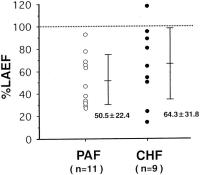
%LAEF in hypertensive patients with paroxysmal atrial fibrillation (PAF) or congestive heart failure (CHF). %LAEF of 6-12 months before CHF or PAF are shown. %LAEF was significantly lower in patients with PAF than in those without PAF. %LAEF was significantly lower in patients with CHF than those without CHF. Keywords: atrial fibrillation,
Atrium,
Diagramm,
Ejektion,
heart failure,
Herzinsuffizienz,
hypertension,
Hypertonie,
LAEF,
LAEF,
left atrial ejection force,
PAF,
Vorhofflimmern
|
|
|
11369. Inoue J;
Ogata T;
Ohtsubo Y;
Tokushima T;
Tsuji S;
Utsunomiya T;
Yoshida K
Left Atrial Ejection Force (LAEF) in Patients With Hypertension: LAEF Is Decreased in Hypertensive Patients With Left Ventricular Failure Or Atrial Fibrillation
LAEF (left atrial ejection force) - Hypertonie
Journal of Clinical and Basic Cardiology 2002; 5 (3): 237-240
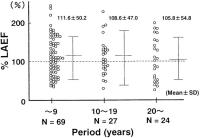
Relationship between period of hypertension and %LAEF. %LAEF was 111.6 % in period less than 9 years, 108.6 % in 10 through 19 years and 105.8 % in over 20 years (on average). %LAEF had a tendency to decrease with period of hypertension,
however, there were no statistically significant differences among the three groups (n.s.). Keywords: Atrium,
Diagramm,
Ejektion,
hypertension,
Hypertonie,
LAEF,
LAEF,
left atrial ejection force
|
|
|
11370. Inoue J;
Ogata T;
Ohtsubo Y;
Tokushima T;
Tsuji S;
Utsunomiya T;
Yoshida K
Left Atrial Ejection Force (LAEF) in Patients With Hypertension: LAEF Is Decreased in Hypertensive Patients With Left Ventricular Failure Or Atrial Fibrillation
LAEF (left atrial ejection force) - WHO-Klassifikation
Journal of Clinical and Basic Cardiology 2002; 5 (3): 237-240
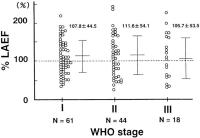
Relationship between WHO stage and %LAEF. %LAEF was 107.8 % in WHO stage I, 111.6 % in stage II and 105.7 % in stage III (on average). %LAEF was slightly higher in stage II than in
stage I, however, there were no statistically significant differences among the three groups. Keywords: Atrium,
classification,
Diagramm,
Ejektion,
Klassifikation,
LAEF,
LAEF,
left atrial ejection force,
Stage,
WHO,
WHO
|
|
|
11371. Inoue J;
Ogata T;
Ohtsubo Y;
Tokushima T;
Tsuji S;
Utsunomiya T;
Yoshida K
Left Atrial Ejection Force (LAEF) in Patients With Hypertension: LAEF Is Decreased in Hypertensive Patients With Left Ventricular Failure Or Atrial Fibrillation
LAEF (left atrial ejection force) - Linksatrialer Durchmesser
Journal of Clinical and Basic Cardiology 2002; 5 (3): 237-240
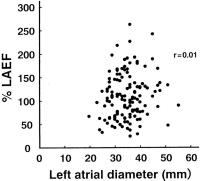
Relationship between left atrial diameter and %LAEF in hypertensive patients. Left atrial diameter ranged from 20 to 55 mm. There were no significant correlations between two parameters
(r = 0.01, n.s.). Keywords: Atrium,
Diagramm,
Diameter,
Durchmesser,
Ejektion,
LAEF,
LAEF,
left atrial ejection force
|
|
|
11372. Inoue J;
Ogata T;
Ohtsubo Y;
Tokushima T;
Tsuji S;
Utsunomiya T;
Yoshida K
Left Atrial Ejection Force (LAEF) in Patients With Hypertension: LAEF Is Decreased in Hypertensive Patients With Left Ventricular Failure Or Atrial Fibrillation
LAEF (left atrial ejection force) - Herzmasse
Journal of Clinical and Basic Cardiology 2002; 5 (3): 237-240
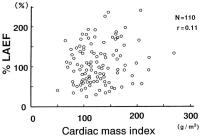
Relationship between cardiac mass index and %LAEF in hypertensive patients. Cardic mass index ranged from 50 to 270 g/m2. There were no significant correlations between two parameters
(r = 0.11, n.s.). Keywords: Atrium,
Cardiac mass,
Diagramm,
Ejektion,
Herzmasse,
LAEF,
LAEF,
left atrial ejection force
|
|
|
11373. Inoue J;
Ogata T;
Ohtsubo Y;
Tokushima T;
Tsuji S;
Utsunomiya T;
Yoshida K
Left Atrial Ejection Force (LAEF) in Patients With Hypertension: LAEF Is Decreased in Hypertensive Patients With Left Ventricular Failure Or Atrial Fibrillation
LAEF (left atrial ejection force) - Alter
Journal of Clinical and Basic Cardiology 2002; 5 (3): 237-240
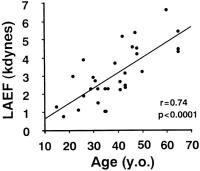
Relationship between LAEF and age in normal subjects. LAEF positively correlated with age. R-value was 0.74 (p < 0.0001), and regression line was LAEF = 0.098 x age – 0.74. Keywords: AGE,
Alter,
Atrium,
Diagramm,
Ejektion,
LAEF,
LAEF,
left atrial ejection force
|
|
|
11374. Inoue J;
Ogata T;
Ohtsubo Y;
Tokushima T;
Tsuji S;
Utsunomiya T;
Yoshida K
Left Atrial Ejection Force (LAEF) in Patients With Hypertension: LAEF Is Decreased in Hypertensive Patients With Left Ventricular Failure Or Atrial Fibrillation
LAEF (Left Atrial Ejection Force)
Journal of Clinical and Basic Cardiology 2002; 5 (3): 237-240
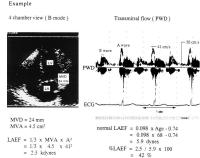
The method for calculating the left atrial ejection force. Left panel shows the schema of four chamber view on twodimensional echocardiogram. As shown by arrow, mitral valve dimension (MVD)
was measured, and mitral valve area (MVA) was calculated as a circle. Right panel shows the schema of transmitral flow velocity on the pulsed wave Doppler (PWD). Left atrial ejection force (LAEF) was calculated using the final equation. Keywords: Atrium,
Auswurf,
echocardiography,
Echokardiographie,
Ejektion,
LAEF,
LAEF,
left atrial ejection force
|
|
|
11375. Kaufmann P;
Gasser R;
Smolle KH
Factors Influencing Outcome in Patients Admitted to a Medical Intensive Care Unit After Successful Cardiopulmonary Resuscitation
Acute Physiology Score
Journal of Clinical and Basic Cardiology 2002; 5 (3): 233-235
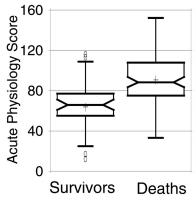
Acute Physiology Scores (APS) in patients after cardiac arrest (hospital survivors and deaths) are displayed by medians of box-and-whisker plots. The data were calculated on the day of admission to the intensive care unit. The plots divide data into 4 areas of equal frequency. The box encloses the middle 50 %. The median is drawn as a horizontal line inside the box (median notch). Two vertical lines extending from each end of the box represent
data distribution from the first and third quartile to the smallest and largest data points within 1.5 interquartile ranges. Far outliers (data points more than 3 interquartile ranges below the first or above the third quartile) are displayed as circles. The location of sample means is indicated by asterisks. Keywords: Acute Physiology Score,
Acute Physiology Score,
cardiac arrest,
death,
Diagramm,
Herzstillstand,
Survivers,
Tod,
Überleben
|
|
|
11376. Waagstein F
Beta-Blockers in Congestive Heart Failure: the Evolution of a New Treatment Concept - Mechanisms of Action and Clinical Implications
Betablocker - Herzinsuffizienz
Journal of Clinical and Basic Cardiology 2002; 5 (3): 215-223
Proven mechanism for beta-blockers in heart failure Keywords: beta-blocker,
Betablocker,
effect,
heart failure,
Herzinsuffizienz,
Schema,
Wirkung
|
|
|
11377. Waagstein F
Beta-Blockers in Congestive Heart Failure: the Evolution of a New Treatment Concept - Mechanisms of Action and Clinical Implications
Betablocker - Phonokardiographie
Journal of Clinical and Basic Cardiology 2002; 5 (3): 215-223
Phonocardiography, pulse curves and echocardiograms before and after withdrawal of beta-blocker Keywords: beta-blocker,
Betablocker,
echocardiography,
Echokardiographie,
heart rate,
Herzfrequenz,
Phonocardiography,
Phonokardiographie
|
|
|
11378. Waagstein F
Beta-Blockers in Congestive Heart Failure: the Evolution of a New Treatment Concept - Mechanisms of Action and Clinical Implications
Myokardinfarkt - Betablockade
Journal of Clinical and Basic Cardiology 2002; 5 (3): 215-223
Effects of acute beta-blockade in acute transmural myocardial infarction Keywords: beta-blocker,
Betablocker,
ischaemia,
Ischämie,
myocardial infarction,
Myokardinfarkt,
Schema
|
|
|
11379. Waagstein F
Beta-Blockers in Congestive Heart Failure: the Evolution of a New Treatment Concept - Mechanisms of Action and Clinical Implications
Herzinsuffizienz - Behandlung
Journal of Clinical and Basic Cardiology 2002; 5 (3): 215-223
Two competing concepts for treating chronic heart failure in 1975 Keywords: Behandlung,
Concept,
heart failure,
Herzinsuffizienz,
Schema,
treatment
|
|
|
11380. Waagstein F
Beta-Blockers in Congestive Heart Failure: the Evolution of a New Treatment Concept - Mechanisms of Action and Clinical Implications
Herzinsuffizienz - Entstehung
Journal of Clinical and Basic Cardiology 2002; 5 (3): 215-223
Development of heart failure after pacing or noradrenaline administration [2, 3] Keywords: Graphische Darstellung,
heart failure,
Herzinsuffizienz,
Noradrenalin,
Noradrenalin,
tachycardia,
Tachykardie
|
|
|
11381. Waagstein F
Beta-Blockers in Congestive Heart Failure: the Evolution of a New Treatment Concept - Mechanisms of Action and Clinical Implications
Todesursachen - NYHA
Journal of Clinical and Basic Cardiology 2002; 5 (3): 215-223
Cause of death in relation to NYHA classification in
congestive heart failure (redrawn after [1]) Keywords: congestive heart failure,
death,
Diagramm,
Herzinsuffizienz,
NYHA classification,
NYHA-Klassifikation,
Todesursache
|
|
|
11382. Rupp H;
Jäger B;
Verboom C-N
Saving Lives Post-MI: Highly Purified Omega-3 PUFAs for the Prevention of Sudden Death
Omega-3-Fettsäuren - Arrhythmien
Journal of Clinical and Basic Cardiology 2002; 5 (3): 209-214
Highly purified omega-3 PUFAs occupy a unique niche among post-MI medications, being the only therapy to target directly the electrical instability of the myocardium Keywords: Antiarrhythmics,
Antiarrhythmikum,
arrhythmia,
Arrhythmie,
myocardium,
Myokard,
omega-3 fatty acid,
Omega-3-Fettsäure,
PUFA,
PUFA,
Schema
|
|
|
11383. Rupp H;
Jäger B;
Verboom C-N
Saving Lives Post-MI: Highly Purified Omega-3 PUFAs for the Prevention of Sudden Death
GISSI-P-Studie - Plötzlicher Herztod
Journal of Clinical and Basic Cardiology 2002; 5 (3): 209-214
There was evidence for a significant reduction in sudden death with highly purified omega-3 PUFAs in the GISSI-Prevenzione study after 4 months of treatment. Most of the early reduction in total
mortality (p = 0.037 at 3 months) was attributable to the reduction in sudden death; modified from [9] (Calculated adjusting for treatment interaction and major confounding variables) Keywords: Diagramm,
GISSI-P study,
GISSI-P-Studie,
omega-3 fatty acid,
Omega-3-Fettsäure,
plötzlicher Herztod,
PUFA,
PUFA,
sudden death
|
|
|
11384. Rupp H;
Jäger B;
Verboom C-N
Saving Lives Post-MI: Highly Purified Omega-3 PUFAs for the Prevention of Sudden Death
GISSI-P - Risikoreduktion
Journal of Clinical and Basic Cardiology 2002; 5 (3): 209-214
Use of highly purified omega-3 PUFAs in GISSI-Prevenzione was associated with significant reductions in the risk of a primary endpoint event (light bars) and reductions in the risk of several
forms of cause-specific mortality (dark bars). Vitamin E alone had no significant effect on either primary outcome and the combination of highly purified omega-3 PUFAs plus vitamin E was not different from highly purified omega-3 PUFAs alone. Risk reductions derived from 4-way analysis; data from [9] Keywords: Diagramm,
Endpoint,
Endpunkt,
GISSI-P study,
GISSI-P-Studie,
omega-3 fatty acid,
Omega-3-Fettsäure,
PUFA,
PUFA,
reduction,
Reduktion,
Risiko,
risk,
Vitamin E,
Vitamin E
|
|
|
11385. Rupp H;
Jäger B;
Verboom C-N
Saving Lives Post-MI: Highly Purified Omega-3 PUFAs for the Prevention of Sudden Death
GISSI-P - Endpunkte
Journal of Clinical and Basic Cardiology 2002; 5 (3): 209-214
Nested endpoints classification used in GISSI-Prevenzione. All endpoints were confirmed by a blinded Endpoint Validation Committee. CVD = cardiovascular (CV) death (any CV cause); CD = cardiac death (any cardiac cause); CHD = coronary death (any coronary cause); data from [8] Keywords: Endpoint,
Endpunkt,
GISSI-P study,
GISSI-P-Studie,
Schema
|
|
|
|
|
|
|
|
|
11388. Lechleitner M
Non Lipid Related Effects of Statins
Endothelzellen - Funktion
Journal of Clinical and Basic Cardiology 2002; 5 (3): 205-208
Endothelial cell function Keywords: cardiology,
Endothel,
endothelium,
Function,
Funktion,
Kardiologie,
Schema
|
|
|
|
|
|
11390. Niessner A;
Huber K;
Niessner H
"Aspirin and Beyond" - Antiplättchensubstanzen in der Therapie der koronaren Herzkrankheit
CLE
Journal für Kardiologie - Austrian Journal of Cardiology 2002; 9 (3): 77-85
Columnar Lined Esophagus (CLE), Zylinderepithel Ösophagus. Keywords: CLE,
Columnar Lined Esophagus,
Kardiologie,
Ösophagus
|
|
|
11391. Zech I;
Vanderzwalmen P;
Zech N
Entwicklung von Embryonen nach intrazytoplasmatischer Spermieninjektion (ICSI) bei "non-male factor" Infertilität in Relation zur Injektionstechnik
Embryonen
Journal für Fertilität und Reproduktion 2002; 12 (3) (Ausgabe für Schweiz): 9-13
Journal für Fertilität und Reproduktion 2002; 12 (3) (Ausgabe für Österreich): 13-18
Grad A Embryonen an Tag 2, 3 und 5 nach Injektion innerhalb oder außerhalb der granulierten Region Keywords: Diagramm,
Embryo,
Fertilität,
Injektionsstelle,
Reproduktion
|
|
|
11392. Zech I;
Vanderzwalmen P;
Zech N
Entwicklung von Embryonen nach intrazytoplasmatischer Spermieninjektion (ICSI) bei "non-male factor" Infertilität in Relation zur Injektionstechnik
Zygotenentwicklung
Journal für Fertilität und Reproduktion 2002; 12 (3) (Ausgabe für Schweiz): 9-13
Journal für Fertilität und Reproduktion 2002; 12 (3) (Ausgabe für Österreich): 13-18
Entwicklung der Zygoten in Relation zur Zytoplasmaaspirations- und Injektionsstelle Keywords: Aspirationsstelle,
Fertilität,
Reproduktion,
Schema,
Zygote,
Zytoplasma
|
|
|
11393. Zech I;
Vanderzwalmen P;
Zech N
Entwicklung von Embryonen nach intrazytoplasmatischer Spermieninjektion (ICSI) bei "non-male factor" Infertilität in Relation zur Injektionstechnik
Embryobeurteilung
Journal für Fertilität und Reproduktion 2002; 12 (3) (Ausgabe für Schweiz): 9-13
Journal für Fertilität und Reproduktion 2002; 12 (3) (Ausgabe für Österreich): 13-18
Embryobeurteilung am Tag 1. Arbeitsblatt zur morphologischen Charakterisierung der Embryonen nach Kriterien verschiedener Autoren in Kombination Keywords: Embryo,
Fertilität,
Morphologie,
Reproduktion,
Schema
|
|
|
|
|
|
11395. Kroiss R;
Führhauser Ch;
Gottesmann C;
Hareter M;
Henzl F;
Kofler P;
Korn V;
Kubista E;
Muhr D;
Traun-Vogt G;
Tritremmel H;
Wagner T
Beratung, Identifikation und Betreuung von Familien mit erblichem Brust- und Eierstockkrebs in Österreich
Mammakarzinom - Ovarialkarzinom - Vererbung
Speculum - Zeitschrift für Gynäkologie und Geburtshilfe 2002; 20 (2) (Ausgabe für Schweiz): 19-19
Speculum - Zeitschrift für Gynäkologie und Geburtshilfe 2002; 20 (2) (Ausgabe für Österreich): 19-23
Ablauf des psychosozialen Follow-up Keywords: BRCA1,
BRCA2,
DNA-Analsyse,
Genetik,
Gynäkologie,
Mammakarzinom,
Onkologie,
Ovarialkarzinom,
psychische Betreuung,
Speculum
|
|
|
11396. Classen HG
Magnesium-L-Aspartat Hydrochlorid: Experimentelle und klinische Studienergebnisse
Magnesium-L-Aspartat-Hydrochlorid
Journal für Mineralstoffwechsel & Muskuloskelettale Erkrankungen 2002; 9 (2): 28-34
Kubische Beziehung zwischen ansteigenden Dosen MAH (im Futter) und biologischen Konzentrationen (mod. nach [16]) Keywords: Diagramm,
Konzentration,
Magnesium-L-Aspartat-Hydrochlorid,
Mineralstoffwechsel,
Nahrung,
Tierversuch
|
|
|
11397. Classen HG
Magnesium-L-Aspartat Hydrochlorid: Experimentelle und klinische Studienergebnisse
Kalzium/Magnesium-Antagonismus
Journal für Mineralstoffwechsel & Muskuloskelettale Erkrankungen 2002; 9 (2): 28-34
Kalzium/Magnesium-Antagonismus am spontan kontrahierenden Ratten-Ileum-Präparat: Nach Zugabe von Mg2+ nimmt die Amplitude um etwa 50 % ab; die Ausgangsamplitude wird wieder erreicht, wenn zusätzlich eine äquimolare Menge an Ca2+ zugegeben wird. Keywords: Ileum,
Kalzium,
Kontraktion,
Konzentration,
magnesium,
Mineralstoffwechsel,
Ratte,
Tierversuch
|
|
|
11398. Classen HG
Magnesium-L-Aspartat Hydrochlorid: Experimentelle und klinische Studienergebnisse
Magnesium-L-Aspartat-Hydrochlorid
Journal für Mineralstoffwechsel & Muskuloskelettale Erkrankungen 2002; 9 (2): 28-34
Magnesium-L-Aspartat-Hydrochlorid Trihydrat Keywords: Magnesium-L-Aspartat-Hydrochlorid,
Mineralstoffwechsel,
Strukturformel
|
|
|
11399. Bernecker PM
Anabole Wirkungen auf den Knochen durch pulsatiles exogenes Parathormon - ein wiederentdecktes Therapieprinzip
Parathormon - Frakturrisiko
Journal für Mineralstoffwechsel & Muskuloskelettale Erkrankungen 2002; 9 (2): 22-24
Senkung des Risikos für nichtvertebrale Frakturen (kumulative Inzidenz) unter pulsatiler rPTH (1-34) Therapie nach durchschnittlich 21 Monaten (modifiziert nach [11]) Keywords: Diagramm,
Fraktur,
Mineralstoffwechsel,
nichtvertebral,
Parathormon,
Risiko,
rPTH
|
|
|
11400. Bernecker PM
Anabole Wirkungen auf den Knochen durch pulsatiles exogenes Parathormon - ein wiederentdecktes Therapieprinzip
Parathormon - Frakturrisiko
Journal für Mineralstoffwechsel & Muskuloskelettale Erkrankungen 2002; 9 (2): 22-24
Senkung des Frakturrisikos für neu aufgetretene Wirbelfrakturen unter pulsatiler rPTH (1-34) Therapie nach durchschnittlich 21 Monaten (modifiziert nach [11]) Keywords: Diagramm,
Fraktur,
Mineralstoffwechsel,
Parathormon,
Risiko,
rPTH,
Wirbelsäule
|
|
|
| |
|

 Suche Medizinische Publikationen
 Suche Abbildungen und Grafiken
 Medizinprodukte - Labortechnik
 Antidotarium (Stand 2012)
 Phytokodex (Stand 2012)
 Fachbücher
 Patientenliteratur