|
|
|---|
8321. Scharla SH;
Barth D;
Lempert UG
Untersuchung zur Verbesserung des Vitamin-D-Stoffwechsels bei Altersheimbewohnern mittels einer Bestrahlung mit ultraviolettem Licht
N-terminale Telopeptide - Urinausscheidung
Journal für Mineralstoffwechsel & Muskuloskelettale Erkrankungen 2006; 13 (2): 47-51
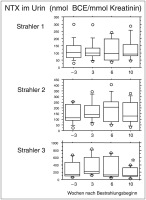
Verlauf der Urin-Ausscheidung von N-terminalen Telopeptiden von Typ 1 Kollagen (NTX) , einem Knochenabbaumarker, unter Bestrahlung
mit 3 verschiedenen UV-Strahlern. Die Werte sind dargestellt als Box-Plot-Diagramm (der Median ist durch den Querbalken repräsentiert,
innerhalb der Box liegen 50 % der Meßwerte, der senkrechte Balken markiert den 90%-Bereich; bei Strahler 2 liegt der Median am unteren
Ende der Box). *p < 0,05 versus Zeitpunkt 3 Wochen. Keywords: Diagramm,
Mineralstoffwechsel,
N-terminales Telopeptid,
Urin
|
|
|
8322. Scharla SH;
Barth D;
Lempert UG
Untersuchung zur Verbesserung des Vitamin-D-Stoffwechsels bei Altersheimbewohnern mittels einer Bestrahlung mit ultraviolettem Licht
25-OH-Vitamin-D-Konzentration
Journal für Mineralstoffwechsel & Muskuloskelettale Erkrankungen 2006; 13 (2): 47-51
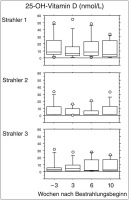
Verlauf der 25-OH-Vitamin D-Konzentration im Serum unter Bestrahlung mit 3 verschiedenen UV-Strahlern. Die Werte sind dargestellt als Box-Plot-Diagramm (der Median ist durch den Querbalken repräsentiert, innerhalb der Box liegen 50 % der Meßwerte, der senkrechte Balken markiert den 90 %-Bereich; bei Strahler 2 liegt der Median am
unteren Ende der Box). Keywords: Diagramm,
Mineralstoffwechsel,
UV-Strahler,
Vitamin D
|
|
|
8323. Bonelli J;
Resch H;
Stoll M
Sinnvolle Osteoporosetherapie
Fraktur - Frau - Alter
Journal für Mineralstoffwechsel & Muskuloskelettale Erkrankungen 2006; 13 (2): 40-46
Exponentieller Anstieg der Frakturraten im Alter bei Frauen ohne Osteoporose (HIP = Schenkelhalsfraktur, WK = Wirbelkörperfraktur,
ANY = alle Frakturen) Keywords: Alter,
Diagramm,
Frau,
Mineralstoffwechsel,
Osteoporose
|
|
|
8324. Bonelli J;
Resch H;
Stoll M
Sinnvolle Osteoporosetherapie
Frakturfreie Überlebenskurve
Journal für Mineralstoffwechsel & Muskuloskelettale Erkrankungen 2006; 13 (2): 40-46
Frakturfreie Überlebenskurven bei Frauen ab dem 50. Lebensjahr: Bei Patienten mit manifester Osteoporose kommt es zu einer
Vorverlegung (Linksverschiebung) der Frakturrate gegenüber der Normalbevölkerung um ca. 8 Jahre. Durch eine effektive Osteoporosetherapie
kann die Kurve nach rechts verschoben, aber nicht normalisiert werden. Keywords: Diagramm,
Frau,
Mineralstoffwechsel,
Osteoporose
|
|
|
8325. Bonelli J;
Resch H;
Stoll M
Sinnvolle Osteoporosetherapie
Wirbelkörperfraktur
Journal für Mineralstoffwechsel & Muskuloskelettale Erkrankungen 2006; 13 (2): 40-46
Kumulative Rate von Wirbelkörperfrakturen unter Placebo und unter Alendronat: Mit 9 Monaten Verspätung sind in der Behandlungsgruppe
genauso viele Frakturen zu verzeichnen wie in der Kontrollgruppe (mod. nach [7]). Keywords: Alendronat,
Diagramm,
Mineralstoffwechsel,
Wirbelkörperfraktur
|
|
|
8326. Schima W
Aktuelle Bilder: Fehllage einer Magensonde
Lungenparenchym
Journal für Gastroenterologische und Hepatologische Erkrankungen 2006; 4 (2): 21
Die 3D-Rekonstruktion der CT zeigt anschaulich den Trakt im Lungenparenchym vom
Unterlappenbronchus bis zur Pleura (Pfeile). Keywords: Gastroenterologie,
Lungenparenchym,
Pleura,
Unterlappenbronchus
|
|
|
8327. Schima W
Aktuelle Bilder: Fehllage einer Magensonde
Pneumothorax
Journal für Gastroenterologische und Hepatologische Erkrankungen 2006; 4 (2): 21
Das axiale CT-Bild zeigt einen großen Pneumothorax, man erkennt das Loch im Lungenparenchym durch die Magensonde
(Pfeil). Keywords: Computertomographie,
CT,
Gastroenterologie,
Pneumothorax
|
|
|
8328. Schima W
Aktuelle Bilder: Fehllage einer Magensonde
Magensonde - Fehllage
Journal für Gastroenterologische und Hepatologische Erkrankungen 2006; 4 (2): 21
Tracheobronchiale Fehllage der Magensonde mit der Spitze im Pleurasinus. Es besteht ein Pneumothorax rechts basal (Pfeile). Keywords: Gastroenterologie,
Magensonde,
Röntgenbild
|
|
|
8329. Cejna M
Chemoembolisation bei hepatozellulärem Karzinom (HCC)
HCC - MRT
Journal für Gastroenterologische und Hepatologische Erkrankungen 2006; 4 (2): 12-16
Darstellung des HCC in der MRT nativ und nach Gabe von Gadolinium (a), Übersichtsangiographie mit Darstellung der pathologischen Gefäße (b) und Zustand nach superselektiver Chemoembolisation
mit deutlichem Pooling des Lipiodol (c). CT-Kontrolle nach 48 h mit Lipiodol markierten HCC nativ und ohne erkennbare Restperfusion in
der arteriellen Phase (d). Keywords: Gadolinium,
HCC,
Hepatologie,
Hepatozelluläres Karzinom,
Magnetresonanztomographie,
MRT
|
|
|
8330. Cejna M
Chemoembolisation bei hepatozellulärem Karzinom (HCC)
HCC - Therapiekonzept
Journal für Gastroenterologische und Hepatologische Erkrankungen 2006; 4 (2): 12-16
Etabliertes Mulitmodales Therapiekonzept des HCC (mod. nach [3]). Keywords: HCC,
Hepatologie,
Hepatozelluläres Karzinom,
Schema,
Therapie
|
|
|
8331. Hammer H;
Schöfl R;
Hammer J
Chronische Pankreatitis: Empfehlungen zur Diagnostik und Therapie. Teil II: Behandlung der chronischen Pankreatitis und der Pankreasinsuffizienz: Diät und Medikamente
WHO - Schmerztherapie
Journal für Gastroenterologische und Hepatologische Erkrankungen 2006; 4 (2): 7-11
Who-Empfehlung zur Schmerztherapie bei Karzinomschmerzen Keywords: Gastroenterologie,
Schema,
Schmerztherapie,
WHO
|
|
|
|
|
|
8333. Parolini O;
Soncini M
Human Placenta: a Source of Progenitor/Stem Cells?
Human term placenta
Journal für Reproduktionsmedizin und Endokrinologie - Journal of Reproductive Medicine and Endocrinology 2006; 3 (2): 117-126
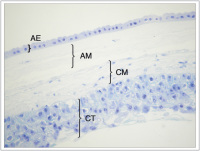
Morphology of fetal membranes of human term placenta (Giemsa staining; AE = amniotic epithelium layer; AM = amniotic mesenchymal
layer; CM = chorionic mesenchymal layer; CT = chorionic trophoblastic layer) Keywords: human term placenta,
Morphologie,
morphology,
Plazenta
|
|
|
8334. Zitzmann M;
Nieschlag E
Testosterone Substitution: Current Modalities and Perspectives
Hypogonadism
Journal für Reproduktionsmedizin und Endokrinologie - Journal of Reproductive Medicine and Endocrinology 2006; 3 (2): 109-116
Flowchart of standardised pathways of diagnostics and treatment of male hypogonadism (T = testosterone; SHBG = sex hormone binding globuline; LH = luteinising hormone; FSH = follicle stimulating hormone; MRI = magnetic resonance imaging; IHH = idiopathic hypogonadotropic hypogonadism) Keywords: Diagramm,
flowchart,
Hypogonadismus,
male hypogonadism,
Mann
|
|
|
8335. Huppertz B
Placental Villous Trophoblast: the Altered Balance Between Proliferation and Apoptosis Triggers Pre-eclampsia
Term placentas
Journal für Reproduktionsmedizin und Endokrinologie - Journal of Reproductive Medicine and Endocrinology 2006; 3 (2): 103-108
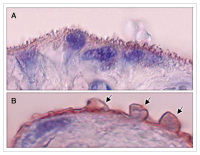
Representative images of chorionic villi from term placentas derived from a normal pregnancy (A) and a pregnancy complicated by late-onset pre-eclampsia (B). In both images staining was performed using a primary antibody against placental-protein 13 (PP13), which is present in the apical membrane of the syncytiotrophoblast. In (A) the normal villous brush border can be seen, which is stained for PP13. In (B) the alterations of the brush border membrane are obvious. Protrusions
on the cellular level can be seen (arrows) that may be released into the maternal circulation. Magnification ×900. Keywords: Plazenta,
pre-eclampsia,
pregnancy,
Präeklampsie,
Schwangerschaft,
term placentas
|
|
|
8336. Huppertz B
Placental Villous Trophoblast: the Altered Balance Between Proliferation and Apoptosis Triggers Pre-eclampsia
Trophoblast turnover
Journal für Reproduktionsmedizin und Endokrinologie - Journal of Reproductive Medicine and Endocrinology 2006; 3 (2): 103-108
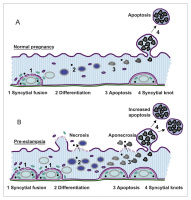
Schematic representation of trophoblast turnover. (A) Normal pregnancy: The final event of cytotrophoblast differentiation, syncytial fusion, results in incorporation of fresh organelles and other cellular
material into the syncytium (1). Within the multinucleated syncytiotrophoblast
differentiation (2) and subsequently late apoptosis (3) take place. Finally, the late apoptotic material is packed into protrusions of the apical plasma membrane, syncytial knots. These knots are released into the maternal circulation as tightly sealed corpuscles (4). (B) Pre-eclampsia: Enhanced proliferation and syncytial fusion (1) may overwhelm the
capacity of the syncytiotrophoblast in terms of differentiation (2) and
apoptotic release (3). This may result in a necrotic breakdown of specific
sites of the syncytiotrophoblast. If at these sites apoptosis has not yet started, pure necrosis can be observed; if however apoptosis has already lead to first cleavage of proteins, apoptotic material will be necrotically released (aponecrosis). At the same time the syncytiotrophoblast tries to counter balance for the increased input by increasing the release of apoptotic syncytial knots (4). Modified from [15]. Keywords: pregnancy,
Schema,
scheme,
Schwangerschaft,
trophoblast
|
|
|
8337. Arck PC;
Knackstedt MK;
Blois SM
Current Insights and Future Perspectives on Neuro-Endocrine-Immune Circuity Challenging Pregnancy Maintenance and Fetal Health
Immunity´s adaption - Pregnancy
Journal für Reproduktionsmedizin und Endokrinologie - Journal of Reproductive Medicine and Endocrinology 2006; 3 (2): 98-102
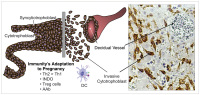
Immunity’s adaptation to pregnancy. Spatial adjacencies of invasive “histoincompatible� cytotrophoblast cells and maternal immune
cells at the interface of fetal and maternal tissues guarantees nourishment of the fetus, but may provoke fetal rejection. Such spatial adjacencies are displayed on the left part of the figure, the right part reveals the in situ appearance in human deciduas basalis at gestation week 10, invasive
trophoblast cells have been labelled by immunohistochemistry employing anti-cytokeratin antibody (magnification ×40). Tolerance mechanisms evolve in the process of immunity’s adaptation to pregnancy comprise the predominance of anti-inflammatory, Th2 cytokines over pro-inflammatory Th1 cytokines, the decidual expression of indoleamine 2, 3-dioxygenase (INDO), the presence of CD4+CD25bright regulatory T (Treg) cells, and the synthesis of asymmetric IgG antibodies (AAbs). In addition, it has become apparent in the past few years that dendritic cells (DCs) seem to be an essential regulatory cell subset at the feto-maternal interface in mediating tolerance. Keywords: cytotrophoblast,
histological examination,
Histologisches Präparat,
Schema,
scheme,
Zytotrophoblast
|
|
|
8338. Arck PC;
Knackstedt MK;
Blois SM
Current Insights and Future Perspectives on Neuro-Endocrine-Immune Circuity Challenging Pregnancy Maintenance and Fetal Health
Stress response
Journal für Reproduktionsmedizin und Endokrinologie - Journal of Reproductive Medicine and Endocrinology 2006; 3 (2): 98-102
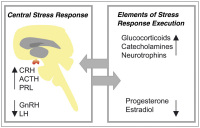
Central stress response and elements of stress response execution. In response to the perception of psychological stress, the central
stress reponse leads to the activation of the HPA axis, which causes the release of CRH, ACTH, and PRL and a down-regulation of GnRH
and LH. Peripheral elements of stress response execution are subsequently activated, including the glucocorticoids, catecholamines, and
neurotrophins. In mice, stress exposure has been shown to result in decrease of progesterone and possibly estradiol. CRH = corticotropinreleasing
hormone; ACTH = adrenocorticotropic hormone; PRL = prolactin; GnRH = gonadotropin-releasing hormone; LH = luteinising hormone;
HPA = hypothalamus-pituitary-adrenal. Keywords: Diagramm,
flowchart,
Stress,
stress response
|
|
|
8339. Arck PC;
Knackstedt MK;
Blois SM
Current Insights and Future Perspectives on Neuro-Endocrine-Immune Circuity Challenging Pregnancy Maintenance and Fetal Health
Stress response
Journal für Reproduktionsmedizin und Endokrinologie - Journal of Reproductive Medicine and Endocrinology 2006; 3 (2): 98-102
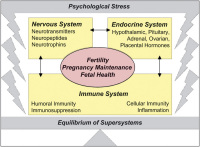
Principles of the stress response. The coordinated cross talk of the three supersystems (nervous, endocrine, and immune system) may
be challenged by psychological stress and ultimately affects fertility, pregnancy maintenance, and fetal health. Keywords: Diagramm,
fertility,
Fertilität,
flowchart,
Stress,
Stress
|
|
|
8340. Koyama K;
Hasegawa A
Premature Ovarian Failure Syndrome May Be Induced by Autoimmune Reactions to Zona Pellucida Proteins
ZP2 peptide
Journal für Reproduktionsmedizin und Endokrinologie - Journal of Reproductive Medicine and Endocrinology 2006; 3 (2): 94-97
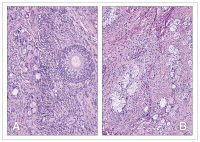
Histological examination of ovarian sections from dog immunised with ZP2 peptide. As compared to the control (A), the ovarian section from the immunised dog showed remarkable impairment (B). No growing follicle was detected and a fibrous change was observed in the interstitial tissue. Keywords: histological examination,
Histologisches Präparat,
ZP2-Peptid
|
|
|
8341. Koyama K;
Hasegawa A
Premature Ovarian Failure Syndrome May Be Induced by Autoimmune Reactions to Zona Pellucida Proteins
Antibodies - ELISA
Journal für Reproduktionsmedizin und Endokrinologie - Journal of Reproductive Medicine and Endocrinology 2006; 3 (2): 94-97
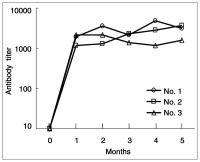
Increase of antibody titers in ELISA against the synthetic peptide used for immunisation. An 18-mer synthetic peptide of dog ZP2 (88–106 amino acids) was prepared and conjugated with a carrier protein, diphtheria toxoid for immunisation. The immunogen (500 µg) was injected with complete Freund’s adjuvant into three 3-month-old dogs
at one-month intervals. Antibody titers were determined by ELISA against the cognate peptide antigen. Keywords: antibody,
Antikörper,
Diagramm,
ELISA,
flowchart
|
|
|
8342. Koyama K;
Hasegawa A
Premature Ovarian Failure Syndrome May Be Induced by Autoimmune Reactions to Zona Pellucida Proteins
POF - oocytes
Journal für Reproduktionsmedizin und Endokrinologie - Journal of Reproductive Medicine and Endocrinology 2006; 3 (2): 94-97
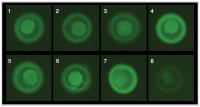
Immunofluorescent staining of human oocytes with sera from POF and the other infertile patients. Isolated human oocytes prepared
as described in Fig. 2 were treated with patients’ diluted sera for one hour at room temperature. After washing with PBS, the treated oocytes
were further incubated in FITC-conjugated anti-human IgG for 50 minutes. Observations were carried out under a fluorescent microscope.
Each number corresponds to the serum samples in Fig. 2. The immunofluorescent intensities did not correlate to the values in the dot immunoassay.
(1)–(5) are oocytes stained with POF patients’ sera, (6) and (7) are oocytes stained with other infertile patients’ sera. (8) is an oocyte
stained with a healthy male’s serum showing a negative reaction in dot immunoassay. Keywords: oocyte,
Oozyte,
POF,
premature ovarian failure
|
|
|
8343. Koyama K;
Hasegawa A
Premature Ovarian Failure Syndrome May Be Induced by Autoimmune Reactions to Zona Pellucida Proteins
Anti-Zona pellucida antibodies
Journal für Reproduktionsmedizin und Endokrinologie - Journal of Reproductive Medicine and Endocrinology 2006; 3 (2): 94-97
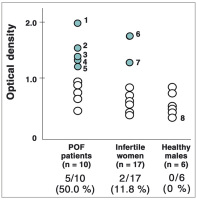
Detection of anti-ZP antibodies in POF patients by dot immunoassay. The human zona pellucida was isolated from unfertilised oocytes
in a clinical program of IVF-ET under informed consent. Solubilised protein (0.01 µg) was dotted onto a nitrocellulose membrane. The membrane
was incubated with the patients’ diluted sera and subsequently treated with an anti-human IgG antibody conjugated with horseradish
peroxidase. Color development was performed by chloronaphthol and H2O2. Densitometric values showing more than twice over the SD values
of the control group (healthy males) were assessed as positive. 50 % (5/10) of POF patients showed positive reaction for anti-zona antibodies,
while 11.8 % (2/17) were positive in the other infertile women. Keywords: antibody,
Antikörper,
Diagramm,
flowchart,
POF,
premature ovarian failure,
Zona pellucida
|
|
|
8344. Koyama K;
Hasegawa A
Premature Ovarian Failure Syndrome May Be Induced by Autoimmune Reactions to Zona Pellucida Proteins
Zona pellucida
Journal für Reproduktionsmedizin und Endokrinologie - Journal of Reproductive Medicine and Endocrinology 2006; 3 (2): 94-97
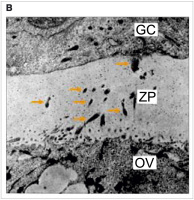
Electron microscopic picture of a mouse oocyte section, demonstrating the zona pellucida (ZP), framed by a granulosa cell (GC) and the oocyte (OV). Protruding micro-villi of the granulosa cell are visible within the ZP. Keywords: electron microscopic picture,
Elektronenmikroskop,
oocyte,
Oozyte,
Zona pellucida
|
|
|
8345. Koyama K;
Hasegawa A
Premature Ovarian Failure Syndrome May Be Induced by Autoimmune Reactions to Zona Pellucida Proteins
Zona pellucida
Journal für Reproduktionsmedizin und Endokrinologie - Journal of Reproductive Medicine and Endocrinology 2006; 3 (2): 94-97
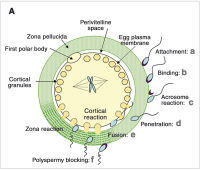
Role of the zona pellucida (ZP) in fertilisation and oocyte maturation. A: Schematic drawing of sperm-ZP interaction (modified from [11]). The capacitated sperm attaches and then tightly binds to the ZP (a, b). These interactions are mediated by ZP3 which serves as a primary receptor
for sperm. The acrosome reaction in the bound sperm is induced which is essential for sperm penetration of ZP (c). ZP2 maintains acrosomereacted sperm in the ZP during penetration (d). Following fusion of egg and sperm, cortical granules disintegrate to induce the zona reaction that prevents polyspermy (e, f). Proteolytic cleavage of ZP2 and ZP3 is involved in the zona reaction. After fertilisation ZP still remains to protect the fertilised eggs. Keywords: Fertilisation,
oocyte maturation,
Oozyte,
Schema,
scheme,
Zona pellucida
|
|
|
8346. Becker M;
Börgermann Ch;
Sperling H;
Rübben H
Varikozele und männliche Infertilität
Schwangerschaft - Varikozele
Blickpunkt der Mann 2006; 4 (2): 26-29
Schwangerschaften nach Beratung (n = 63) und Therapie (n = 62) bislang kinderloser Paare mit Varikozele beim männlichen Partner in einem Beobachtungszeitraum von 12 Monaten. Keywords: Andrologie,
Beratung,
Diagramm,
Schwangerschaft,
Therapie,
Varikozele
|
|
|
|
|
|
8348. Becker M;
Börgermann Ch;
Sperling H;
Rübben H
Varikozele und männliche Infertilität
Varikozele
Blickpunkt der Mann 2006; 4 (2): 26-29
Farbdopplersonographie der Varikozele Keywords: Andrologie,
Farbdoppler,
Varikozele
|
|
|
8349. Becker M;
Börgermann Ch;
Sperling H;
Rübben H
Varikozele und männliche Infertilität
Varikozele
Blickpunkt der Mann 2006; 4 (2): 26-29
Varikozele mit ausgeprägtem Kollateralkreislauf Keywords: Andrologie,
scheme,
Varikozele
|
|
|
8350. Haidl G
Die klinische Untersuchung in der Andrologie
Hodensonographie
Blickpunkt der Mann 2006; 4 (2): 23-25
Hodensonographie; links: sog. "Schneegestöber"-Muster, rechts: normaler Hoden Keywords: Andrologie,
Hoden,
Sonographie
|
|
|
8351. Schulte-Wefers H;
Wolfersdorf M
Suizidalität bei Männern
Krisenmodell - Krankheitsmodell
Blickpunkt der Mann 2006; 4 (2): 10-18
Keywords: Andrologie
|
|
|
|
|
|
8353. Luef G
Epilepsie und Schwangerschaft
Central Registry
Speculum - Zeitschrift für Gynäkologie und Geburtshilfe 2006; 24 (2) (Ausgabe für Schweiz): 23-23
Speculum - Zeitschrift für Gynäkologie und Geburtshilfe 2006; 24 (2) (Ausgabe für Österreich): 23-32
Daten vom 27. Dezember 2005, verfügbar im "Central Registry". Im Moment haben mehr als 750 teilnehmende Ärzte aus 39 Ländern Schwangerschaften gemeldet. Keywords: Diagramm,
Geburtshilfe,
Register,
Schwangerschaft,
Speculum
|
|
|
8354. Häusler M
Ultraschall in der Schwangerschaft - die Qualitätsfrage
Ultraschallgerät - Intensität
Speculum - Zeitschrift für Gynäkologie und Geburtshilfe 2006; 24 (2) (Ausgabe für Schweiz): 12-12
Speculum - Zeitschrift für Gynäkologie und Geburtshilfe 2006; 24 (2) (Ausgabe für Österreich): 12-22
Anstieg der Intensitäten moderner Ultraschallgeräte (Ispta, Iob) und Leistungen (W) (Kollmann Ch., persönliche Mitteilung, Daten aus [24, 25]). Keywords: Diagramm,
Geburtshilfe,
Speculum,
Ultraschall
|
|
|
8355. Häusler M
Ultraschall in der Schwangerschaft - die Qualitätsfrage
Ultraschalluntersuchung - Schwangerschaft
Speculum - Zeitschrift für Gynäkologie und Geburtshilfe 2006; 24 (2) (Ausgabe für Schweiz): 12-12
Speculum - Zeitschrift für Gynäkologie und Geburtshilfe 2006; 24 (2) (Ausgabe für Österreich): 12-22
Graphische Darstellung der Ultraschalluntersuchungen in der Schwangerschaft in Österreich (Status quo und angestrebte Erweiterung), Deutschland im Vergleich Keywords: Deutschland,
Diagramm,
Geburtshilfe,
Schwangerschaft,
Speculum,
Ultraschall,
Österreich
|
|
|
|
|
|
|
|
|
|
|
|
|
|
|
8360. Wallner H
Fallbericht: OMI - Obstruktive Mesenterialischämie
Abschlußarteriographie
Zeitschrift für Gefäßmedizin 2006; 3 (2): 18
Abschlußarteriographie Keywords: Arteriographie,
Gefäßmedizin
|
|
|
| |

 Suche Medizinische Publikationen
 Suche Abbildungen und Grafiken
 Medizinprodukte - Labortechnik
 Antidotarium (Stand 2012)
 Phytokodex (Stand 2012)
 Fachbücher
 Patientenliteratur