| |
| Alle Journale wurden nach durchsucht |
Treffer 11921 - 11960 von 11970 |
|
|
|---|
11921. Holzmann S;
Dittrich P;
Pöch G
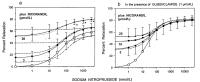
Dose-response curves of vasorelaxants: computerized calculation of combination effects using the example of nicorandil
Dosiswirkungsbeziehung - Nitroprussid
Journal of Clinical and Basic Cardiology 1999; 2 (1): 96-98
Cumulative dose-response curves (DRCs) of nitroprusside in the absence (open symbol) and presence of 3-20 micromol/L nicorandil (filled symbols), a) in the absence, b) in the presence of 1 micromol/L glibenclamide. The symbols and bars
represent experimental mean values from 12 experiments and 95 % CI. Experimental DRCs are shown by solid lines, theoretical DRCs by dashed lines (dose-additivity) and dotted lines independence). For graphical clarity, the following theoretical curves are shown in a) bands of 95 % CI with upper and lower boundary of dose-additive
combinations of nitroprusside in the presence of 3 and 20 micromol/L nicorandil, curve of mean independent effect of nitroprusside in the presence of 20 micromol/L nicorandil, b) means of dose-additive combinations of nitroprusside with 3, 10, and 20 micromol/L nicorandil. The effects of nicorandil alone are shown on the y-axis. Significant deviation from dose-additivity is indicated by asterics. Keywords: Diagramm,
Glibenclamid,
glibenclamide,
Nicorandil,
Nicorandil,
vasorelaxation,
vasorelaxation
|
|
|
11922. Peters RM;
Silberstein T
Changes in left ventricular filling dynamics with treadmill exercise in normal and hypertensive subjects
Linksventrikuläre Füllung - Belastung
Journal of Clinical and Basic Cardiology 1999; 2 (1): 89-91
Changes in Doppler left ventricular filling indexes at peak rates immediately post exercise, compared to rest. E % change, percentage change of the mean peak velocity of early filling; A % change, percentage change of the mean peak velocity of late filling; E/A % change, percentage change of mean early to late filling ratio Keywords: Belastung,
Diagramm,
exercise,
Füllung,
left ventricle,
left ventricular filling,
linker Ventrikel
|
|
|
11923. Lörincz I;
Karányi Z;
Kun C;
Wórum F
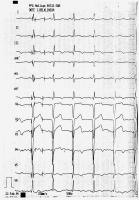
Reduced QT dispersion after early thrombolysis - protection of ventricular electrical stability
QT-Dispersion nach Thromoblyse
Journal of Clinical and Basic Cardiology 1999; 2 (1): 85-88
The illustrative example of the typical measurement of JT and QT intervals. It shows the inability to measure the end of T wave in leads aVR and V6. I, II, Ill, aVR, aVL, aVF and V1-5 ECG leads Keywords: ECG,
EKG,
electrocardiography,
Elektrokardiographie,
JT-interval,
JT-Intervall,
QT-dispersion,
QT-dispersion,
QT-interval,
QT-Intervall,
Thrombolyse,
thrombolysis
|
|
|
11924. Lörincz I;
Karányi Z;
Kun C;
Wórum F
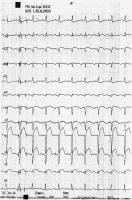
Reduced QT dispersion after early thrombolysis - protection of ventricular electrical stability
QT-Dispersion nach Thrombolyse
Journal of Clinical and Basic Cardiology 1999; 2 (1): 85-88
The illustrative example of the typical measurement of JT and QT intervals; I, II, III, aVR, aVL, aVF and V1-5 ECG leads Keywords: ECG,
EKG,
electrocardiography,
Elektrokardiographie,
JT-interval,
JT-Intervall,
QT-dispersion,
QT-dispersion,
QT-interval,
QT-Intervall,
Thrombolyse,
thrombolysis
|
|
|
11925. Lejko-Zupanc T;
Kozelj M;
Kranjec I;
Pikelj F
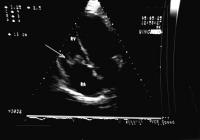
Right sided endocarditis: clinical and echocardiographic characteristics
Rechtsseitige Endokarditis
Journal of Clinical and Basic Cardiology 1999; 2 (1): 81-84
Apical four chamber recording showing a large vegetation on the tricuspid valve (arrow); RA = right atrium, RV = right ventricle Keywords: echocardiography,
Echokardiographie,
endocarditis,
Endokarditis,
rechter Ventrikel,
rechtes Atrium,
right atrium,
right ventricle,
tricuspid valve,
Trikuspidalklappe,
Vegetation,
Vegetation
|
|
|
11926. Hief C;
Klösch C;
Podczeck A;
Steinbach K
Can atrial flutter be converted to sinus rhythm by antiarrhythmic drugs or should atrial pacing be performed?
Vorhofflattern - Antiarrhythmika
Journal of Clinical and Basic Cardiology 1999; 2 (1): 78-80
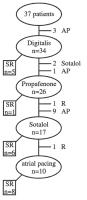
Efficacy of oral antiarrhythmics in patients with
sustained atrial flutter. A step-wise protocol was performed (AP: atrial pacing was performed and terminated atrial flutter in sinus rhythm in all patients; R: patient refuses additional therapy). Keywords: Antiarrhythmics,
Antiarrhythmikum,
atrial flutter,
Digitalis,
Digitalis,
pacemaker,
Propafenon,
propafenone,
Schema,
Schrittmacher,
Sotalol,
Sotalol,
Vorhofflattern
|
|
|
11927. Letizia C;
Cerci S;
D'Erasmo E;
Scavo D;
Scuro L;
Subioli S
Effects of captopril on plasma endothelin-1 in patients with essential hypertension
Plasmaendothelin 1 nach Captopril
Journal of Clinical and Basic Cardiology 1999; 2 (1): 75-77
Plasma endothelin-1 levels in both group after captopril administration Keywords: captopril,
captopril,
Diagramm,
endothelin-1,
endothelin-1,
essential hypertension,
Hypertonie
|
|
|
11928. Birand A;
Akgul F;
Bozkurt A;
Kudaiberdieva GZ;
Saliu S;
Topcuoglu MS
Serial changes of heart rate variability after coronary artery bypass surgery
Herzfrequenzvariabilität nach CABG
Journal of Clinical and Basic Cardiology 1999; 2 (1): 69-72
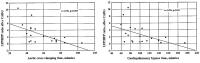
2. Relationship of LFP/HFP ratio with aortic cross-clamping time (a) and total cardiopulmonary bypass time (b) Keywords: Aortenklemmzeit,
aortic cross-clamping time,
Bypass,
Bypass,
cardiopulmonary bypass time,
Diagramm,
heart rate,
Herzfrequenz,
Kardiopulmonare Bypasszeit,
variability,
Variabilität
|
|
|
11929. Birand A;
Akgul F;
Bozkurt A;
Kudaiberdieva GZ;
Saliu S;
Topcuoglu MS
Serial changes of heart rate variability after coronary artery bypass surgery
Herzfrequenzvariabilität nach CABG
Journal of Clinical and Basic Cardiology 1999; 2 (1): 69-72
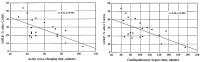
Relationship of LFRP with aortic cross-clamping time (a) and total cardiopulmonary bypass time (b) Keywords: Aortenklemmzeit,
aortic cross-clamping time,
Bypass,
Bypass,
cardiopulmonary bypass time,
Diagramm,
heart rate,
Herzfrequenz,
Kardiopulmonare Bypasszeit,
variability,
Variabilität
|
|
|
11930. Ising H;
Babisch W;
Günther T
Work noise as a risk factor in myocardial infarction
Lärmwirkung
Journal of Clinical and Basic Cardiology 1999; 2 (1): 64-68
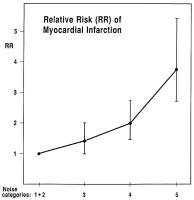
Relative risk (RR) of MI in men (and 95 % confidence intervals) by work noise category. Work noise was assessed by subjective loudness comparison with typical noise sources (1+2: refrigerator + typewriter, 3: electric lawn-mower, 4: electric drill, 5: road drill). Relative risk of MI (ICD 410) was adjusted for covariates (smoking, body mass index, age, social class, education, marital status, shift work, housing area) using logistic analysis. Keywords: Diagramm,
Lärm,
myocardial infarction,
Myokardinfarkt,
noise,
Risiko,
risk
|
|
|
11931. Ising H;
Babisch W;
Günther T
Work noise as a risk factor in myocardial infarction
Lärmwirkung
Journal of Clinical and Basic Cardiology 1999; 2 (1): 64-68
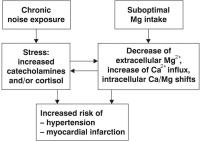
Interaction model of noise-induced endocrine reactions ad electrolyte shifts resulting in increased cardiovascular risk Keywords: cardiovascular risk,
electrolyte,
Elektrolyt,
endocrinology,
Endokrinologie,
kardiovaskuläres Risiko,
Lärm,
noise,
Schema
|
|
|
11932. Ising H;
Babisch W;
Günther T
Work noise as a risk factor in myocardial infarction
Lärmwahrnehmung - Lärmwirkung
Journal of Clinical and Basic Cardiology 1999; 2 (1): 64-68
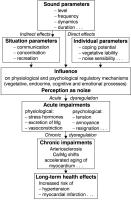
Model of noise perception and psychophysiological effects of noise, risk factors and cardiovascular diseases Keywords: cardiovascular disease,
kardiovaskuläre Erkrankung,
Lärm,
noise,
Physiologie,
physiology,
Psychologie,
psychology,
Risikofaktor,
risk factor,
Schema
|
|
|
11933. Gasser R;
Klein W
Some observations and pathophysiological considerations concerning KATP-channels and coronary heart disease
Autopräkonditionierung - Myokardinfarkt
Journal of Clinical and Basic Cardiology 1999; 2 (1): 15-18
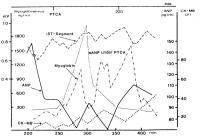
Phenomenon of autopreconditioning. During the early phase of acute myocardial infarction, various parameters of ischaemia are subject to changes: ST-elevation, CK-MB, myoglobin as well as ANP rise and fall in an episodic manner. They reflect alternating phases of coronary artery occlusion and spontaneous reperfusion. PTCA, in contrast, only causes one peak in the ANPconcentration curve, as we see only one occlusion and one reperfusion (see figure 4). Keywords: autopreconditioning,
Autopräkonditionierung,
Diagramm,
myocardial infarction,
Myokardinfarkt
|
|
|
11934. Gasser R;
Klein W
Some observations and pathophysiological considerations concerning KATP-channels and coronary heart disease
Koronararterie - Dilatation
Journal of Clinical and Basic Cardiology 1999; 2 (1): 15-18
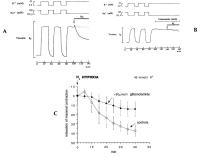
Pig coronary artery precontracted with potassium-rich Tyrode solution:
A: When 100 % oxygen is switched to 100 % nitrogen in the perfusate (simulation of ischaemia) and instantaneous dilation of the artery occurs.
B: Tolbutamide, a specific blocker of KATP-channels leads to an inhibition of these mechanisms, hypoxic vasodilation is inhibited.
C: Serial experiments on the inhibition of hypoxy coronary dilation using glibenclamide and other specific blockers of KATP-channels. Keywords: Arteria coronaria,
Arteria coronaria,
Dilatation,
dilation,
Glibenclamid,
glibenclamide,
Kaliumkanal,
potassium channel,
Tolbutamid,
tolbutamide
|
|
|
11935. Gasser R;
Klein W
Some observations and pathophysiological considerations concerning KATP-channels and coronary heart disease
ANP-Freisetzung nach Ischämie
Journal of Clinical and Basic Cardiology 1999; 2 (1): 15-18
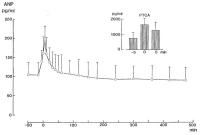
Liberation of atrionatriuretic peptide after a short ischaemic episode (PTCA of LAD) in patients with coronary heart disease. The inset shows the concentrations of ANP in the coronary sinus. The curve with open symbols shows the ANP-concentrations of patients from the antecubital vene. The fast rise of ANP leads to peripheral vasodilation, coronary dilatation and elimination of volume by strong diuresis. These mechanisms are cardioprotective by reducing pre- and afterload. Keywords: ANP,
ANP,
Atrial Natriuretic Peptide,
Diagramm,
ischaemia,
Ischämie
|
|
|
11936. Purcell H;
Fox K
Potassium channel openers in myocardial ischaemia - clinical experience with nicorandil
Nicorandil - instabile Angina pectoris
Journal of Clinical and Basic Cardiology 1999; 2 (1): 12-14
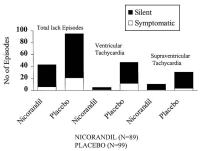
Nicorandil in unstable angina (adapted from Patel DJ et al.[14]) Keywords: Diagramm,
instabile Angina pectoris,
Nicorandil,
Nicorandil,
unstable angina pectoris
|
|
|
11937. Purcell H;
Fox K
Potassium channel openers in myocardial ischaemia - clinical experience with nicorandil
Nicorandil - Wirkmechanismus
Journal of Clinical and Basic Cardiology 1999; 2 (1): 12-14
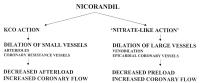
Mechanism of action of nicorandil (KCO, Potassium channel opener) Keywords: Kaliumkanalöffner,
mechnism of action,
Nicorandil,
Nicorandil,
potassium channel opener,
Schema,
Wirkmechanismus
|
|
|
11938. Smith ELK;
Fan T-PD;
Hainsworth AH;
Hiley CR;
Lauder H
Vascular endothelial growth factor (VEGF)and endothelin-3 (ET-3) activate cation currents in human umbilical vein endothelial cells
VEGF und ET-3 - Gefäßpermeabilität
Journal of Clinical and Basic Cardiology 1998; 1 (1): 52-54
Effect of acute endothelin-3 (ET-3) treatment on whole cell currents recorded from a single HUVEC on the edge of a wound. Current voltage relations are shown before ET-3 application (control), at the end of a 10 min exposure to 100 nmol/L ET-3 after which ET-3 was removed, then 60 min after ET-3 removal (recovery). Cell 511072. Whole cell capacitance 29pF, series resistance 8 MOhm. Keywords: cation,
current,
Diagramm,
Endothel,
endothelin-3,
endothelin-3,
endothelium,
Kation,
Nabelschnur,
Strom,
umbilical vein
|
|
|
11939. Smith ELK;
Fan T-PD;
Hainsworth AH;
Hiley CR;
Lauder H
Vascular endothelial growth factor (VEGF)and endothelin-3 (ET-3) activate cation currents in human umbilical vein endothelial cells
VEGF und ET-3 - Gefäßpermeabilität
Journal of Clinical and Basic Cardiology 1998; 1 (1): 52-54
Current voltage relations derived from the same cell as in Figure 1, before (control) and at the end of a 10 min exposure to VEGF (20 pmol/L) then 60 min after VEGF removal (recovery). Note the inward rectifier current present at voltages more negative than -80mV throughout this recording. Keywords: cation,
current,
Diagramm,
Endothel,
endothelium,
Kation,
Nabelschnur,
Strom,
umbilical vein,
Vascular Endothelial Growth Factor,
Vascular Endothelial Growth Factor
|
|
|
11940. Smith ELK;
Fan T-PD;
Hainsworth AH;
Hiley CR;
Lauder H
Vascular endothelial growth factor (VEGF)and endothelin-3 (ET-3) activate cation currents in human umbilical vein endothelial cells
VEGV und ET-3 - Gefäßpermeabilität
Journal of Clinical and Basic Cardiology 1998; 1 (1): 52-54
Effect of acute exposure to vascular endothelial growth factor (VEGF) on whole cell currents recorded from human umbilical vein endothelial cells (HUVEC) on the edge of a regrowing boundary. Whole cell currents before (upper traces) and at the end of 10 min in VEGF (20 pmol/L) containing solution (middle traces). From a holding potential of -60mV, brief pulses to -100, -60, -20 and +40mV were applied (pulse protocol shown in bottom trace). Whole cell capacitance 24 pF, series resistance 5.5 MΩ. Currents are shown with residual capacity transients manually erased. Cell 601252. Keywords: cation,
current,
Diagramm,
Endothel,
endothelin-3,
endothelin-3,
endothelium,
Kation,
Nabelschnur,
Strom,
umbilical vein,
Vascular Endothelial Growth Factor,
Vascular Endothelial Growth Factor
|
|
|
11941. Gasser R;
Horn S;
Köppel H
Discrimination by valinomycin K-selective surface microelectrodes of a sulphonylurea-sensitive and a distinct sulphonylurea-, barium-, TEA- and cinnamate-insensitive component of K-efflux from isolated pig coronary arteries during simulated ischaemia
K-Efflux in Koronararterien
Journal of Clinical and Basic Cardiology 1998; 1 (1): 43-51
Glibenclamide partially inhibits ischaemia induced K+-efflux in an isolated pig coronary artery strip. Left and right hand panel from the same preparation. Glibenclamide added 20 minutes before beginning of trace on the right hand panel. Gap in trace represents 30 minutes. The addition of 1 mM Ba2+ does not inhibit the glibenclamide-insensitive component of ischaemia induced K+ efflux Keywords: Arteria coronaria,
Arteria coronaria,
Diagramm,
Efflux,
Efflux,
Glibenclamid,
glibenclamide,
ischaemia,
Ischämie,
Kalium,
potassium
|
|
|
11942. Gasser R;
Horn S;
Köppel H
Discrimination by valinomycin K-selective surface microelectrodes of a sulphonylurea-sensitive and a distinct sulphonylurea-, barium-, TEA- and cinnamate-insensitive component of K-efflux from isolated pig coronary arteries during simulated ischaemia
K-Efflux in Koronararterien
Journal of Clinical and Basic Cardiology 1998; 1 (1): 43-51
A. Lack of effect of alpha-cyano-4-hydroxycinnamate (cinnamate, a lactate transport inhibitor) on ischaemia induced K+ efflux in an isolated pig coronary artery strip. Preparation has been incubated with 4 mM cinnamate for 15 minutes before beginning of trace in right hand panel. Left and right hand panel from the same preparation. Gap represents 20 min. B. In Cl-- free solution (Cl- replaced by glucuronate one hour before testing the effect of simulated ischaemia) rate and extent of K+ accumulation are the same as in the presence of Cl-. Gap represents 60 min. Left and right hand panel from the same
preparation (like in A). Keywords: Arteria coronaria,
Arteria coronaria,
Cinnamat,
cinnamate,
Diagramm,
Efflux,
Efflux,
ischaemia,
Ischämie,
Kalium,
potassium
|
|
|
11943. Gasser R;
Horn S;
Köppel H
Discrimination by valinomycin K-selective surface microelectrodes of a sulphonylurea-sensitive and a distinct sulphonylurea-, barium-, TEA- and cinnamate-insensitive component of K-efflux from isolated pig coronary arteries during simulated ischaemia
K-Efflux in Koronararterien
Journal of Clinical and Basic Cardiology 1998; 1 (1): 43-51
Ischaemia induced K+ accumulation in 6 isolated pig coronary artery strips in the presence (closed symbols) and absence (open symbols) of glibenclamide (50 microM). Data from experiments similar to those in Figures 4 and 6. Keywords: Arteria coronaria,
Arteria coronaria,
Diagramm,
Efflux,
Efflux,
Glibenclamid,
glibenclamide,
ischaemia,
Ischämie,
Kalium,
potassium
|
|
|
11944. Gasser R;
Horn S;
Köppel H
Discrimination by valinomycin K-selective surface microelectrodes of a sulphonylurea-sensitive and a distinct sulphonylurea-, barium-, TEA- and cinnamate-insensitive component of K-efflux from isolated pig coronary arteries during simulated ischaemia
K-Efflux in Koronararterien
Journal of Clinical and Basic Cardiology 1998; 1 (1): 43-51
Effect of tetramethylpyrazine (a non-sulfonylurea compound known to block K+ATP channels in various tissues, in the literature also named ligustrazine) during simulated ischaemia in an isolated pig coronary artery preparation. Tetramethylpyrazine reduces rate and extent of K+-efflux from the tissue. Left and right hand panel from the same preparation. Tetramethylpyrazine added 20 min before beginning of trace on the right hand panel. Gap represents 30 min. Keywords: Arteria coronaria,
Arteria coronaria,
Diagramm,
Efflux,
Efflux,
ischaemia,
Ischämie,
Kalium,
potassium,
tetramethylpyrazin,
tetramethylpyrazin
|
|
|
11945. Gasser R;
Horn S;
Köppel H
Discrimination by valinomycin K-selective surface microelectrodes of a sulphonylurea-sensitive and a distinct sulphonylurea-, barium-, TEA- and cinnamate-insensitive component of K-efflux from isolated pig coronary arteries during simulated ischaemia
K-Efflux in Koronararterien
Journal of Clinical and Basic Cardiology 1998; 1 (1): 43-51
Measurement of Na+ with Na+ selective microelectrode during simulated ischaemia in an isolated pig coronary artery strip. Na+s did not change throughout the ischaemic episode, indicating a steady state of transmembrane Na+-movement during early simulated ischaemia in this preparation. In the presence of glibenclamide (50 microM), Na+ also remained unchanged. Left and
right hand panel from the same preparation. Glibenclamide added 20 minutes before beginning of trace on the right hand panel. Like in Figure 4, left and right hand panel from the same preparation Keywords: Arteria coronaria,
Arteria coronaria,
Diagramm,
Efflux,
Efflux,
Glibenclamid,
glibenclamide,
ischaemia,
Ischämie,
Kalium,
potassium
|
|
|
11946. Gasser R;
Horn S;
Köppel H
Discrimination by valinomycin K-selective surface microelectrodes of a sulphonylurea-sensitive and a distinct sulphonylurea-, barium-, TEA- and cinnamate-insensitive component of K-efflux from isolated pig coronary arteries during simulated ischaemia
K-Efflux in Koronararterien
Journal of Clinical and Basic Cardiology 1998; 1 (1): 43-51
Effect of glibenclamide during simulated ischaemia in an isolated pig coronary artery preparation. Glibenclamide (50 microM) reduces rate and extent of K+ efflux from the tissue. Left and right hand panel from the same preparation. Glibenclamide added 20 minutes before beginning of trace on the right hand side panel. Gap in trace represents 30 min Keywords: Arteria coronaria,
Arteria coronaria,
Diagramm,
Efflux,
Efflux,
Glibenclamid,
glibenclamide,
ischaemia,
Ischämie,
Kalium,
potassium
|
|
|
11947. Gasser R;
Horn S;
Köppel H
Discrimination by valinomycin K-selective surface microelectrodes of a sulphonylurea-sensitive and a distinct sulphonylurea-, barium-, TEA- and cinnamate-insensitive component of K-efflux from isolated pig coronary arteries during simulated ischaemia
K-Efflux in Koronararterien
Journal of Clinical and Basic Cardiology 1998; 1 (1): 43-51
Guinea pig papillary muscle. Typical results when measuring K+ during an ischaemic episode. A. Experiment performed using an electrode bevelled with a 45° angle pushed too deeply into the preparation - penetrating approximately two or three layers of myocardial cells. Right handside panel: lack of effect of glibenclamide upon ischaemic K+ efflux in the same experiment, when microelectrode pushed too deeply into the tissue. B. Ideal experimental conditions: flat-tipped surface
microelectrode gently touching the preparation like in Figure 2. Glibenclamide (100 microM) prevents early ischaemia-induced K+ efflux. Keywords: Arteria coronaria,
Arteria coronaria,
Diagramm,
Efflux,
Efflux,
Glibenclamid,
glibenclamide,
ischaemia,
Ischämie,
Kalium,
potassium
|
|
|
11948. Gasser R;
Horn S;
Köppel H
Discrimination by valinomycin K-selective surface microelectrodes of a sulphonylurea-sensitive and a distinct sulphonylurea-, barium-, TEA- and cinnamate-insensitive component of K-efflux from isolated pig coronary arteries during simulated ischaemia
K-Efflux in Koronararterien - Mikroelektroden
Journal of Clinical and Basic Cardiology 1998; 1 (1): 43-51
Simplified diagram of different microelectrode tips during simulated ischaemia. Hatched area represents paraffin oil (P.o.), area underneath, marked with oval rings, represents myocardial or smooth muscle tissue (T). Between tissue and P.o. one can see the artificially created reduced extra-cellular space (ARECS). a. Electrode tip bevelled in a 45° angle not yielding ideal contact with the tissue surface, thus making contact with the paraffin oil. Under these conditions the hydrophobic carrier will instantly escape from the tip and the electrode does not give further readings. b. Elec-trode tip bevelled in a 45° angle pushed too deeply into the tissue causing cell damage. Cells will be
either damaged or destroyed causing a constant leak of K+(K+ ions represented by stippling) into the ARECS which, in turn, leads to faulty measurements: instead of ischaemia-induced K+ efflux caused by changed K+ conductance of the membrane the electrode measures changes resulting from damaged cells (c.f. Fig. 3). c. Electrode tip bevelled in a 90° angle (flat tip) ideally positioned in the ARECS. Only under these circumstances correct measurements of transmembrane K+ efflux induced by ischaemia are possible (c.f. Fig. 3). d. Ideally bevelled surface microelectrode, impaled too deeply into the tissue. Stippling represents K+ ions leaking from damaged tissue - readings will be misleading. e. Too fine-tipped microelectrode, pushed too deeply into the tissue. Leaking K+ from the damaged tissue like in b and d, represented by stippling and small arrows. Keywords: Arteria coronaria,
Arteria coronaria,
Efflux,
Efflux,
Graphische Darstellung,
ischaemia,
Ischämie,
Kalium,
microelectrode,
Mikroelektrode,
potassium
|
|
|
11949. Gasser R;
Horn S;
Köppel H
Discrimination by valinomycin K-selective surface microelectrodes of a sulphonylurea-sensitive and a distinct sulphonylurea-, barium-, TEA- and cinnamate-insensitive component of K-efflux from isolated pig coronary arteries during simulated ischaemia
K-Efflux in Koronararterien - Versuchsanordnung
Journal of Clinical and Basic Cardiology 1998; 1 (1): 43-51
Experimental assembly used for simulating ischaemia. Fig. redrawn from Gasser & Vaughan-Jones (1990). Schematic diagram of perfusion chamber. Ion-selective microelectrode (in our experiments e.g. Na+, pH, K+- selective microelectrode) pressed gently on the surface of a pig coronary artery strip and recording specific ion concentration changes during ischaemia. Preparation is laid across four supports (micropins, 100 µm in diameter) and pinned on one end and attached to a force transducer at the other. Also shown are two electrodes for field Stimulation. The diagram illustrates an episode of simulated ischaemia, with the preparation immersed almost completely in a stationary pool of paraffin oil (heavy stippling) while perfusion of warm (37 °C) Tyrode (light stippling) continues at the base of the chamber. Dashed lines represent ligated areas as described in the Methods. Keywords: Arteria coronaria,
Arteria coronaria,
Efflux,
Efflux,
Graphische Darstellung,
ischaemia,
Ischämie,
Kalium,
microelectrode,
Mikroelektrode,
potassium
|
|
|
11950. Di Napoli P;
Barsotti A;
Contegiacomo G;
Di Crecchio A;
Di Muzio M;
Maggi A;
Taccardi AA;
Tiloca P
Ischaemic preconditioning of rat myocardium: effects on postischaemic coronary endothelium hyperpermeability and microcirculatory damage
Preconditioning - koronare Mikrozirkulation
Journal of Clinical and Basic Cardiology 1998; 1 (1): 37-42
Histological samples (200X, fluorescent light) showing the FITC-Albumin diffusion in perimyocytic space (left) and perivascular space (right). Top: control. Middle: preconditioning. Bottom: preconditioning + hypertonic reperfusion. In control group fluorescence is strongly diffused around myocytes and perivascular space. After ischaemic preconditioning, albumin extravasation is limited; adding hypertonic reperfusion FlTC-albumin diffusion is detected in the only endothelial surface of blood vessels (bottom, on the right) Keywords: FITC-albumin,
FITC-albumin,
Histologisches Präparat,
histology,
ischaemic preconditioning,
ischämisches Preconditioning,
microcirculation,
Mikrozirkulation
|
|
|
11951. Di Napoli P;
Barsotti A;
Contegiacomo G;
Di Crecchio A;
Di Muzio M;
Maggi A;
Taccardi AA;
Tiloca P
Ischaemic preconditioning of rat myocardium: effects on postischaemic coronary endothelium hyperpermeability and microcirculatory damage
Preconditioning - koronare Mikrozirkulation
Journal of Clinical and Basic Cardiology 1998; 1 (1): 37-42
Arrhythmic score Keywords: arrhythmia,
Arrhythmie,
Diagramm,
ischaemic preconditioning,
ischämisches Preconditioning,
microcirculation,
Mikrozirkulation
|
|
|
11952. Di Napoli P;
Barsotti A;
Contegiacomo G;
Di Crecchio A;
Di Muzio M;
Maggi A;
Taccardi AA;
Tiloca P
Ischaemic preconditioning of rat myocardium: effects on postischaemic coronary endothelium hyperpermeability and microcirculatory damage
Preconditioning - koronare Mikrozirkulation
Journal of Clinical and Basic Cardiology 1998; 1 (1): 37-42
Time-course of enzymatic release in coronary effluent (CPK, LDH). Data are expressed as mean +/- SD. Keywords: creatine kinase,
Diagramm,
Enzym,
enzyme,
ischaemic preconditioning,
ischämisches Preconditioning,
Kreatinkinase,
lactatdehydrogenase,
Laktatdehydrogenase,
microcirculation,
Mikrozirkulation
|
|
|
11953. Di Napoli P;
Barsotti A;
Contegiacomo G;
Di Crecchio A;
Di Muzio M;
Maggi A;
Taccardi AA;
Tiloca P
Ischaemic preconditioning of rat myocardium: effects on postischaemic coronary endothelium hyperpermeability and microcirculatory damage
Preconditioning - koronare Mikrozirkulation
Journal of Clinical and Basic Cardiology 1998; 1 (1): 37-42
Haemodynamic parameters (systolic aortic pressure, heart rate, cardiac output). SAP: systolic aortic pressure. Data are expressed as mean +/- SD. Keywords: cardiac output,
cardiac output,
Diagramm,
heart rate,
Herzfrequenz,
ischaemic preconditioning,
ischämisches Preconditioning,
microcirculation,
Mikrozirkulation,
systolic blood pressure,
systolischer Blutdruck
|
|
|
11954. Di Napoli P;
Barsotti A;
Contegiacomo G;
Di Crecchio A;
Di Muzio M;
Maggi A;
Taccardi AA;
Tiloca P
Ischaemic preconditioning of rat myocardium: effects on postischaemic coronary endothelium hyperpermeability and microcirculatory damage
Preconditioning - koronare Mikrozirkulation
Journal of Clinical and Basic Cardiology 1998; 1 (1): 37-42
Haemodynamic parameters (aortic flow, coronary flow, minute work). Data are expressed as mean +/- SD. Keywords: blood flow,
Blutfluss,
Diagramm,
ischaemic preconditioning,
ischämisches Preconditioning,
microcirculation,
Mikrozirkulation
|
|
|
11955. Di Napoli P;
Barsotti A;
Contegiacomo G;
Di Crecchio A;
Di Muzio M;
Maggi A;
Taccardi AA;
Tiloca P
Ischaemic preconditioning of rat myocardium: effects on postischaemic coronary endothelium hyperpermeability and microcirculatory damage
Preconditioning - koronare Mikrozirkulation
Journal of Clinical and Basic Cardiology 1998; 1 (1): 37-42
Experimental protocol. w.h.: working heart perfusion. Lang.: Langendorff reperfusion. FITC-AIb.: Fluorescein Isothiocyanate-Albumin. HC: Histologic control. Keywords: Design,
Design,
ischaemic preconditioning,
ischämisches Preconditioning,
microcirculation,
Mikrozirkulation,
protocol,
Protokoll,
Schema
|
|
|
11956. Wilke A;
Arndt T;
Ferency I;
Hesse H;
Kaiser A;
Maisch B
Carbohydrate-deficient transferrin in patients with alcoholic cardiomyopathy
Alkoholische Kardiomyopathie - CDT
Journal of Clinical and Basic Cardiology 1998; 1 (1): 34-36
CDT and Alcohol Intake. Comment: The dispersion is high in patients with high alcohol intake. The reason could be that these patients are not able to estimate their alcohol consumption. Keywords: alcohol,
alcoholic cardiomyopathy,
Alkohol,
alkoholische Kardiomyopathie,
Carbohydrat-defizientes Transferrin,
carbohydrate-deficient transferrin,
Diagramm
|
|
|
11957. Vincelj J;
Bergovec M;
Putarek K;
Sokol I
Pre-hospital factors influencing the time to administration of thrombolytic therapy in acute myocardial infarction in Zagreb region
Akuter Myokardinfarkt - Zeit bis Thrombolyse
Journal of Clinical and Basic Cardiology 1998; 1 (1): 30-33
Time elapsed from symptom onset to initiation of TT in patient with AMI (call-to-needle time) Keywords: acute myocardial infarction,
akuter Myokardinfarkt,
Diagramm,
Thrombolyse,
thrombolysis
|
|
|
11958. Vincelj J;
Bergovec M;
Putarek K;
Sokol I
Pre-hospital factors influencing the time to administration of thrombolytic therapy in acute myocardial infarction in Zagreb region
Akuter Myokardinfarkt - Alter
Journal of Clinical and Basic Cardiology 1998; 1 (1): 30-33
Distribution of patients with AMI according to age Keywords: acute myocardial infarction,
AGE,
akuter Myokardinfarkt,
Alter,
Diagramm
|
|
|
11959. Laederach-Hofmann K;
Friedrich S;
Jürgensen R;
Mussgay L
Paraverbal speech stylistics in patients with chest pain and normal coronary angiography: is this method helpful in diagnosing underlying pathology?
Sprache und Brustschmerz
Journal of Clinical and Basic Cardiology 1998; 1 (1): 25-29
Plosive words (left upper figure), speed of speech (right upper figure), repeated words (left lower figure), and swallowed words (right lower figure) in patients with SYX and PD during nonstress and stress-interviews. Open bars denote no-pain sections, Keywords: chest pain,
Diagramm,
speech,
speech stylistics,
Sprache,
Sprachstil,
Stress,
Stress,
Thoraxschmerz
|
|
|
11960. Berger R;
Frey B;
Hülsmann M;
Koller-Strametz J;
Pacher R;
Sima I;
Stanek B
Delayed effects of one-year treatment with low-dose as compared with high-dose enalapril on morbidity and mortality of patients with severe heart failure
Enalapril bei schwerer Herzinsuffizienz - Überleben
Journal of Clinical and Basic Cardiology 1998; 1 (1): 19-24
Kaplan Meier survival curves in 42 patients allocated to the low-dose extension group and in 41 patients allocated to the high-dose extension group. Keywords: Diagramm,
Enalapril,
Enalapril,
Kaplan-Meier-curve,
Kaplan-Meier-Kurve,
mortality,
Mortalität,
Studie,
study,
survival,
Überleben
|
|
|
| |
|

 Suche Medizinische Publikationen
 Suche Abbildungen und Grafiken
 Medizinprodukte - Labortechnik
 Antidotarium (Stand 2012)
 Phytokodex (Stand 2012)
 Fachbücher
 Patientenliteratur